
5 key benefits of cryptocurrencies in online gambling

Most gamblers assume that traditional payment methods like credit cards and bank transfers represent the safest, most reliable path to funding their accounts. That assumption is increasingly difficult to defend. Cryptocurrencies now offer measurable advantages in privacy, transaction speed, cost efficiency, and game fairness verification that no conventional payment system can replicate. This article breaks down exactly how crypto changes the gambling experience, where the genuine benefits are, where the risks remain, and how to position yourself to take full advantage of blockchain-powered play.
Key Takeaways
| Point | Details |
|---|---|
| Enhanced privacy | Crypto gambling allows you to play without sharing personal bank details. |
| Fast, secure payments | Deposits and withdrawals are instant, with lower fees and no chargebacks. |
| Provable game fairness | Some games let you verify fairness independently, though not all titles qualify. |
| Volatility strategies | Stablecoins help you control crypto price swings while you play. |
Why privacy and anonymity set crypto gambling apart
The most immediate reason experienced players migrate to crypto is the fundamental shift in how personal data is handled. With traditional payment methods, every deposit creates a record linking your banking identity to your gambling activity. Credit card statements, bank logs, and e-wallet transaction histories all generate a detailed paper trail. Cryptocurrency removes that linkage entirely.

When you fund a casino account with Bitcoin or Ethereum, only wallet addresses are exchanged. No personal banking details are shared, no credit card numbers are transmitted, and no identity documents are required at the payment level. As noted by LiveBitcoinNews, privacy advantages of crypto gambling include enhanced anonymity since only wallet addresses are used rather than personal banking credentials, which also helps players bypass regional access restrictions.
This matters for several distinct reasons:
- Geographic access: Players in regions where gambling is restricted by local banking regulations can often transact freely via crypto, since no bank intermediary is involved.
- Discretion: Crypto transactions do not appear as gambling-related entries on bank statements, which is relevant for players who prefer financial privacy.
- Reduced data exposure: Fewer personal details transmitted means fewer attack surfaces for data breaches.
- Faster onboarding: Many crypto casinos require minimal KYC (Know Your Customer) verification at the payment stage, reducing friction for new players.
“Enhanced privacy and anonymity as no personal banking details are shared, only wallet addresses; useful for bypassing restrictions.” — LiveBitcoinNews
This privacy architecture also opens access to a broader range of game types. Players exploring crypto craps advantages or crypto blackjack on platforms built for blockchain transactions benefit from this streamlined, low-friction deposit process that traditional payment rails simply cannot match.
Privacy is not absolute, however. On-chain transactions are publicly visible on the blockchain, meaning wallet activity can be traced by anyone with the right tools. Using fresh wallet addresses for each transaction and understanding the public nature of blockchain records remains important for players who prioritize discretion.
Transaction speed and cost: Crypto vs. traditional payments
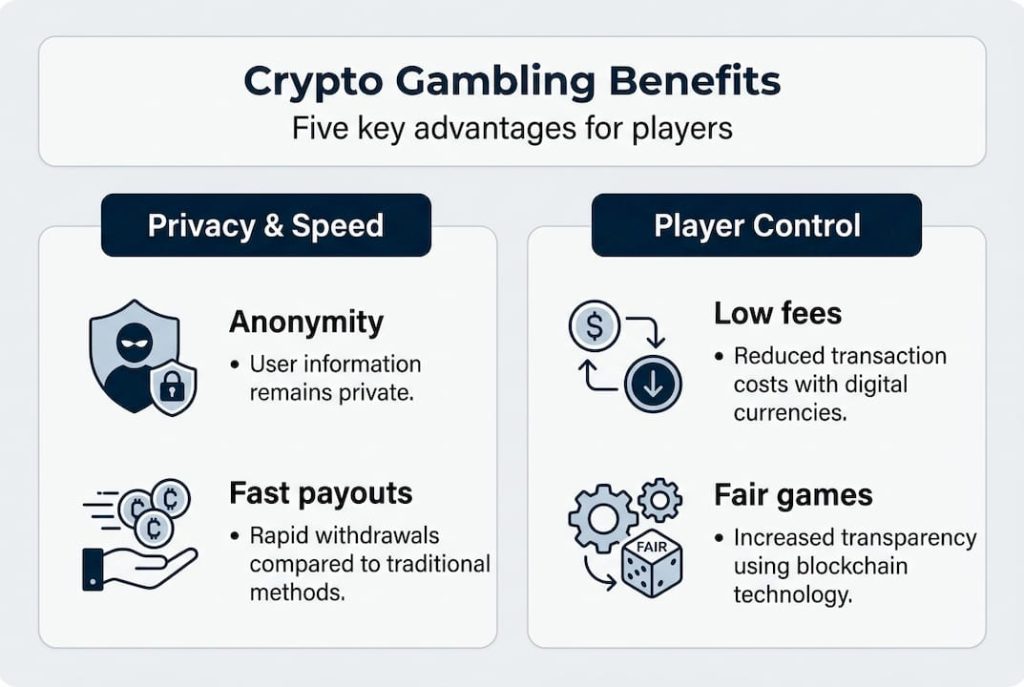
Beyond privacy, the mechanics of moving money with crypto are objectively faster and cheaper than most traditional alternatives. Credit card deposits can take minutes to clear and carry processing fees of 1.5% to 3.5%. Bank wire transfers can take two to five business days. Crypto transactions, depending on the network and congestion, typically settle in seconds to minutes.
| Payment method | Deposit speed | Withdrawal speed | Typical fee |
|---|---|---|---|
| Credit card | Instant | 3 to 7 days | 1.5% to 3.5% |
| Bank wire | 1 to 2 days | 3 to 5 days | $15 to $50 flat |
| E-wallet | Instant | 24 to 48 hours | 1% to 2.5% |
| Bitcoin | 10 to 30 min | 10 to 30 min | $0.50 to $3 |
| Litecoin/DOGE | Under 5 min | Under 5 min | Under $0.10 |
The chargeback issue is equally significant. Traditional payment processors allow customers to dispute and reverse transactions, which creates fraud risk for both casinos and players. Blockchain immutability eliminates this entirely. According to Corytech, no chargebacks possible due to blockchain immutability reduces fraud risk for operators and players alike, creating a more stable financial environment for both sides of the transaction.
Here is a practical step-by-step overview of how a Bitcoin deposit works at a crypto casino benefits platform:
- Copy the casino-provided Bitcoin deposit address from your account dashboard.
- Open your personal crypto wallet and initiate a send transaction to that address.
- Specify the amount and confirm the transaction fee (network fee, not a casino fee).
- Wait for one to three blockchain confirmations, typically 10 to 30 minutes for Bitcoin.
- Funds appear in your casino balance, ready to wager immediately.
Pro Tip: If speed is a priority, consider using Litecoin or Dogecoin instead of Bitcoin. These networks typically confirm in under five minutes and carry fees well below $0.10 per transaction, making them ideal for frequent depositors.
Provably fair gaming: Trust through transparency
One of the most technically significant innovations in crypto gambling is the concept of provably fair gaming. This system uses cryptographic methods to let players independently verify that a game outcome was not manipulated after the fact.
The mechanism works as follows: before a game round begins, the casino generates a server seed (a random string of characters) and provides the player with a hashed version of it. The player can also contribute their own client seed. After the round, the server seed is revealed, and anyone can input both seeds into the published algorithm to confirm the result was mathematically determined before the bet was placed.
| Component | Role in verification |
|---|---|
| Server seed | Generated by casino before round; hashed for player |
| Client seed | Provided by player; adds randomness |
| Nonce | Increments with each bet to ensure unique outcomes |
| Hash function | Combines seeds to produce verifiable result |
As documented by Crypto Economy, provably fair mechanics using cryptographic seeds and hashes allow players to independently verify game outcomes, which builds a level of trust that traditional RNG (random number generator) audits cannot offer in real time.
However, there is a critical limitation that many guides overlook:
- Provably fair systems typically apply only to in-house developed games, which represent roughly 5% to 10% of a typical crypto casino’s catalog.
- Third-party slot titles and live dealer games from major providers use audited RNG systems instead, which are verified by testing labs like eCOGRA or iTech Labs but are not independently verifiable by players in real time.
- The term “provably fair” is sometimes applied loosely to games that do not actually support full cryptographic verification.
Players should verify which specific titles on a platform support full seed-based verification before treating the entire catalog as provably fair.
For a detailed breakdown of how this works in practice, the provably fair explanation page outlines the verification process step by step. Players interested in testing this system should start with in-house crypto games where the mechanism is genuinely implemented.
Risks, volatility, and how to game smarter with crypto
Crypto gambling’s advantages are real, but so are its risks. The most operationally significant risk for active players is price volatility. Bitcoin or Ethereum values can shift meaningfully within a single session, meaning a balance that was worth $500 when you deposited could be worth $480 or $520 by the time you withdraw, independent of your gambling results.
According to Bitget’s analysis, volatility exposure during sessions can produce swings of 0.4% to 1.3% on a $1,000 deposit within a short timeframe, with stablecoins identified as the primary mitigation tool for players who want to isolate gambling outcomes from market movements.
Additional risks worth understanding:
- Irreversible transactions: Sending funds to the wrong address has no recovery mechanism. Always double-check wallet addresses before confirming.
- Tax and regulatory uncertainty: In most jurisdictions, crypto gambling winnings are taxable events, and the regulatory landscape continues to evolve in 2026.
- Technical knowledge barrier: Managing private keys, understanding gas fees, and selecting the right network requires a baseline of crypto literacy that traditional banking does not demand.
- Provably fair overconfidence: As noted in Medium’s analysis, the term is frequently misapplied, with only 5% to 10% of catalogs genuinely supporting full verification.
Pro Tip: Use USDT or USDC (both USD-pegged stablecoins) for your session bankroll if you want to eliminate volatility from the equation entirely. Convert to or from Bitcoin at transfer points rather than holding volatile assets as your active balance.
Reviewing how top crypto casino players manage their bankrolls can also provide practical benchmarks for session budgeting and game selection strategies.
Our take: What most guides get wrong about crypto gambling
Most introductory guides to crypto gambling present provably fair as a platform-wide feature. It is not. In practice, provably fair verification applies to a narrow slice of any casino’s game library, typically the original in-house titles. The other 90% to 95% of games, including the slots, live tables, and sports markets that most players actually use, rely on third-party RNG audits that are credible but not player-verifiable in real time.
This distinction matters because overconfidence in trust signals leads to under-scrutiny of the games you are actually playing. The smarter approach is to treat provably fair as a meaningful but limited feature, verify it specifically on the deep dive into provable fairness page for each title you intend to play, and apply the same critical evaluation to third-party game providers that you would to any audited system.
Volatility is similarly underweighted in most guides. A 1% swing on a session bankroll sounds minor until you realize that swing is entirely outside your control and stacks on top of the house edge. Education, not enthusiasm, is the most valuable asset a crypto gambler can hold.
Ready to experience the crypto edge?
Understanding the mechanics of crypto gambling is only the first step. Applying that knowledge on a platform built for transparency, speed, and fairness is where it translates into real advantage.

Wolfbet provides access to all crypto casino games including slots, dice, and crypto table games with full crypto payment integration and provably fair mechanics on eligible titles. For players committed to long-term play, the VIP crypto club offers tiered rewards structured around consistent volume and loyalty. Every transaction on the platform processes through blockchain infrastructure, meaning deposits and withdrawals move at network speed with no banking intermediaries involved.
Frequently asked questions
How do cryptocurrency deposits and withdrawals work at online casinos?
Players send funds from their crypto wallet to a casino-provided address, with near-instant crediting on most networks. Withdrawals reverse the process, with no personal banking details required at any stage.
What is ‘provably fair’ in crypto gambling, and are all games provably fair?
Provably fair means a game’s outcome can be cryptographically verified by the player, but this feature is limited to in-house titles covering roughly 5% to 10% of a typical catalog, not all games.
How can I avoid volatility risks when gambling with crypto?
Using stablecoins like USDT or USDC eliminates price exposure during sessions, since these assets maintain a fixed USD peg. Volatility during sessions can otherwise swing a $1,000 balance by 0.4% to 1.3% independent of game results.
Are crypto gambling winnings taxable?
In most jurisdictions, crypto gambling winnings are treated as taxable income or capital gains events; tax rules vary significantly by country, so consulting local regulations or a qualified tax advisor is the recommended course of action.
Recommended
- WOLFBET | Licensed Crypto Casino | Bitcoin slots & live games
- Crypto Craps & Bitcoin Craps online – Wolfbet Crypto Casino
- Bitcoin live roulette – Wolfbet Crypto Casino
- Top Ranking Crypto Casino Players – Wolfbet Crypto Casino
About the author
Marcus
123 articlesTrending
Aztec Magic Megaways Review

Wolf.Bet Weekly Recap #2

Penguins Megaways Slot Review: Unlock 4,591x with Unlimited Progressive Multipliers
Zeus Lightning Megaways by Red Tiger Review



![Tumble Feature: A Dynamic Way to Win More [GUIDE]](https://wolfbet.com/blog/wp-content/uploads/2025/01/tumble-feature-slot-games-768x439.webp)