
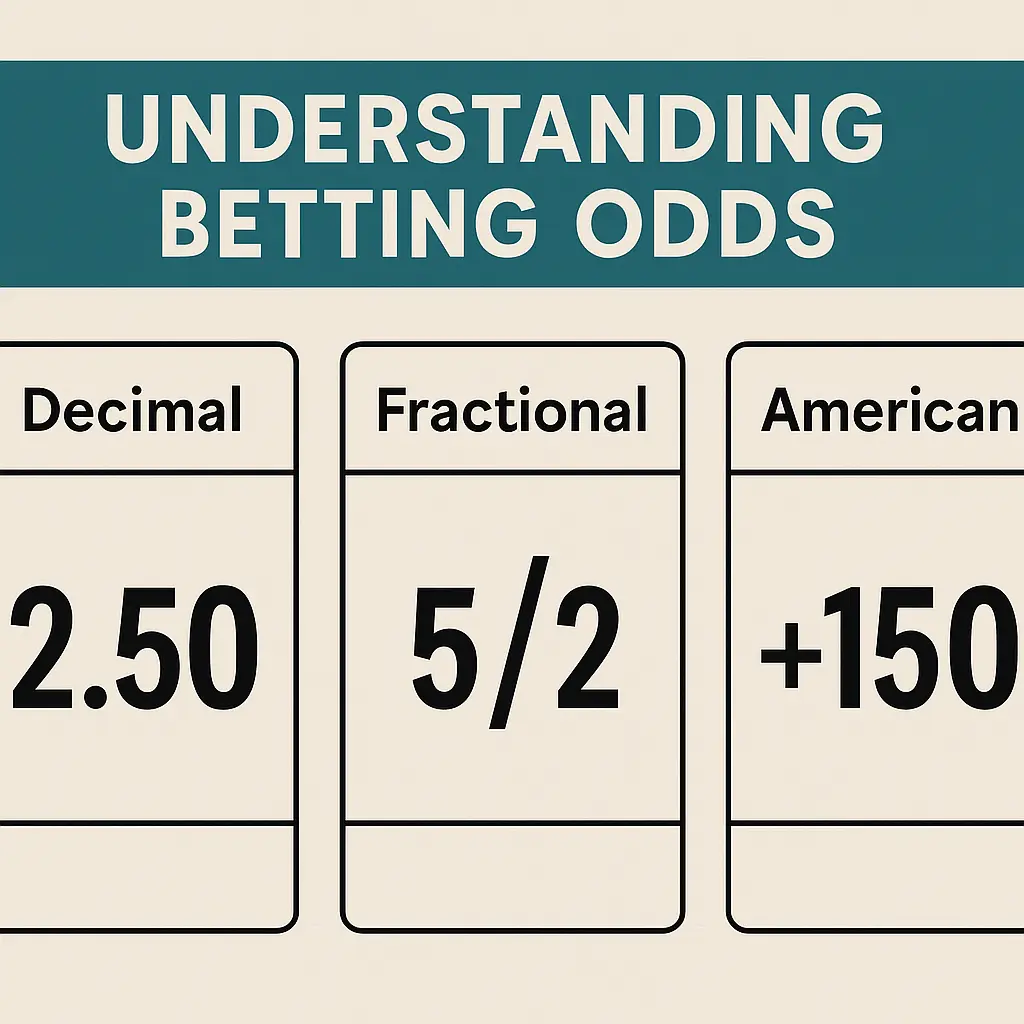
You’ve just opened a sportsbook for the first time. There’s a football match you fancy, but the numbers next to each team look like they’re written in three different languages. One site shows 2.50, another displays 5/2, and a third presents +150. They all represent the same thing, yet they couldn’t look more different.
If this scenario sounds familiar, you’re not alone. Betting odds confuse millions of newcomers every year, and for good reason. These numbers serve two crucial purposes simultaneously: they indicate how likely an outcome is to happen, and they tell you exactly how much money you stand to win. Master them, and you unlock the ability to spot value across any bookmaker worldwide. Ignore them, and you’re essentially gambling blind.
This guide breaks down all three major odds formats used globally. By the time you finish reading, you’ll convert between them effortlessly, calculate potential payouts in seconds, and understand the implied probability hidden within every price. Let’s start with the basics.
What Do Betting Odds Actually Represent?
Before diving into specific formats, it’s worth understanding what odds fundamentally communicate. At their core, betting odds are a numerical representation of two things: the likelihood of something happening and the return you’ll receive if it does.
Think of a simple coin flip. The true probability of heads or tails is exactly 50%. In a perfectly fair world, odds would reflect this precisely. However, bookmakers aren’t running charities. They need to make money, which means they adjust the odds slightly in their favour.
This adjustment is called the margin, overround, or vigorish (often shortened to “vig” or “juice”). Instead of offering true 50/50 odds on a coin flip, a bookmaker might price both outcomes at around 47.6% implied probability each. That extra 4.8% combined represents their built-in profit margin.
Understanding this distinction between “true odds” and “bookmaker odds” is fundamental. The odds you see never perfectly reflect actual probability. They’re always tilted slightly toward the house. This is why comparing prices across multiple bookmakers matters so much.
Decimal Odds: The Most Straightforward Format
Decimal odds dominate throughout Europe, Australia, Canada, and most online betting platforms worldwide. Their popularity stems from one simple fact: they’re the easiest format to understand and calculate.
The decimal number represents your total return for every unit staked, including your original stake. The calculation couldn’t be simpler.
Total Return = Stake × Decimal Odds
Suppose you bet £10 at odds of 2.50. Your calculation is simply 10 × 2.50 = £25 total return. Since £10 was your original stake, your actual profit is £15.
Here are a few more examples to cement the concept. At odds of 2.00, a £10 stake returns £20 total, meaning £10 profit. At odds of 1.50, that same £10 returns £15, giving you £5 profit. And at odds of 3.75, you’d receive £37.50 back, pocketing £27.50 profit.
Converting Decimal Odds to Implied Probability
To understand what chance the bookmaker is giving an outcome, use this formula:
Implied Probability = (1 ÷ Decimal Odds) × 100
Odds of 2.00 translate to (1 ÷ 2.00) × 100 = 50% implied probability. Odds of 1.25 suggest (1 ÷ 1.25) × 100 = 80% implied probability. The lower the decimal number, the more likely the bookmaker considers that outcome.
The beauty of decimal odds lies in their transparency. There’s no mental gymnastics required. You see the number, multiply by your stake, and know exactly what comes back. Comparing value across different bets takes seconds rather than minutes.
Fractional Odds: The Traditional British Format
Walk into any British bookmaker or watch horse racing coverage from the UK, and you’ll encounter fractional odds everywhere. This traditional format remains deeply embedded in British and Irish betting culture, particularly around the tracks.
Fractional odds show your potential profit relative to your stake. The key difference from decimal odds is that the fraction represents profit only, not your total return.
Reading them is straightforward once you grasp the concept. The first number (numerator) tells you how much profit you’ll make, while the second number (denominator) represents your stake.
At 5/1 (spoken as “five-to-one”), you win £5 for every £1 staked. Your stake comes back too, so a £10 bet returns £60 total (£50 profit plus £10 stake). At 1/5 (spoken as “one-to-five” or “five-to-one on”), you win just £1 for every £5 staked. This indicates a heavy favourite. At 11/4, you win £11 for every £4 staked.
Essential Fractional Odds Terminology
“Odds against” describes any fraction where the first number exceeds the second (like 5/1 or 3/2). These are underdogs or less likely outcomes. “Odds on” is the opposite, where the second number is larger (like 1/5 or 4/9). These represent favourites. “Evens” or “1/1” means you double your money, equivalent to a 50% implied probability.
Converting Fractional Odds to Implied Probability
Implied Probability = Denominator ÷ (Numerator + Denominator) × 100
For 3/1 odds, the calculation is 1 ÷ (3 + 1) × 100 = 25% implied probability. For 1/4 odds, it’s 4 ÷ (1 + 4) × 100 = 80% implied probability.
Converting fractional to decimal odds is also simple. Divide the fraction and add 1. So 5/2 becomes (5 ÷ 2) + 1 = 3.50 in decimal format.
American Odds: Understanding Plus and Minus
American odds, also called moneyline odds, take a completely different approach. They use positive and negative numbers based on a $100 reference point, and they’re the standard format throughout the United States.
Negative Odds (Favourites)
A negative number tells you how much you must stake to win $100 profit. If you see -150, you need to bet $150 to win $100. The larger the negative number, the heavier the favourite. Odds of -300 mean betting $300 to win $100, indicating the bookmaker considers this outcome very likely.
Positive Odds (Underdogs)
A positive number shows how much profit you’d make on a $100 stake. Odds of +200 mean a $100 bet returns $200 profit (plus your stake back). The larger the positive number, the bigger the underdog. Seeing +500 suggests a significant long shot.
Calculating Payouts with American Odds
For negative odds: Profit = (Stake ÷ Odds) × 100
Betting $75 at -150 means profit = (75 ÷ 150) × 100 = $50
For positive odds: Profit = (Stake × Odds) ÷ 100
Betting $50 at +200 means profit = (50 × 200) ÷ 100 = $100
Converting American Odds to Implied Probability
For negative odds: Implied Probability = Odds ÷ (Odds + 100) × 100
Odds of -200 translate to 200 ÷ (200 + 100) × 100 = 66.7%
For positive odds: Implied Probability = 100 ÷ (Odds + 100) × 100
Odds of +150 translate to 100 ÷ (150 + 100) × 100 = 40%
How to Convert Between All Three Formats
Being fluent in all formats lets you compare odds across international bookmakers instantly. Here are the key conversion methods.
Decimal to Fractional: Subtract 1 from the decimal, then express as a fraction. Decimal 2.50 becomes 1.50, which simplifies to 3/2.
Decimal to American: If the decimal is 2.00 or higher, multiply (Decimal – 1) by 100 for a positive moneyline. So 3.00 becomes (3.00 – 1) × 100 = +200. If below 2.00, divide -100 by (Decimal – 1). So 1.50 becomes -100 ÷ 0.50 = -200.
Fractional to Decimal: Divide the fraction and add 1. So 5/2 becomes 2.5 + 1 = 3.50.
American to Decimal: For positive odds, divide by 100 and add 1. So +200 becomes (200 ÷ 100) + 1 = 3.00. For negative odds, divide 100 by the odds (ignoring the minus) and add 1. So -200 becomes (100 ÷ 200) + 1 = 1.50.
Using Implied Probability to Find Value
Understanding odds formats is only half the battle. The real skill lies in identifying value, which happens when you believe the true probability of an outcome exceeds what the bookmaker’s odds suggest.
Suppose a bookmaker offers 3.00 (2/1, +200) on a team winning, implying a 33.3% chance. If your analysis suggests they actually have a 40% chance of winning, you’ve potentially found value. Over time, consistently betting when you identify such discrepancies can prove profitable.
This is also where understanding the bookmaker’s margin becomes important. In a two-outcome market priced at -110/-110 (American), both sides have implied probabilities around 52.4%. That’s 104.8% total, meaning a 4.8% margin for the house. Lower margins generally mean better value for bettors.
Complete Betting Odds Conversion Chart
| Decimal | Fractional | American | Implied Probability |
|---|---|---|---|
| 1.25 | 1/4 | -400 | 80% |
| 1.50 | 1/2 | -200 | 66.7% |
| 1.80 | 4/5 | -125 | 55.6% |
| 2.00 | 1/1 (Evens) | +100 | 50% |
| 2.50 | 3/2 | +150 | 40% |
| 3.00 | 2/1 | +200 | 33.3% |
| 4.00 | 3/1 | +300 | 25% |
| 5.00 | 4/1 | +400 | 20% |
| 6.00 | 5/1 | +500 | 16.7% |
| 10.00 | 9/1 | +900 | 10% |
| 21.00 | 20/1 | +2000 | 4.8% |
Putting Your Odds Knowledge Into Practice
Most modern sportsbooks let you switch between odds formats in your account settings. Use this feature to practice until conversions become second nature.
A helpful baseline to memorise: decimal 2.00 equals evens (1/1) equals +100. This represents exactly 50% implied probability and the point where you double your money. Everything else relates back to this anchor point. Decimal 3.00 is 2/1 is +200. Decimal 1.50 is 1/2 is -200.
Avoid common mistakes that trip up beginners. Don’t confuse total return with profit when using decimal odds. Don’t misread fractional odds as decimals (3/1 is very different from 3.1). And always remember that decimal odds include your stake in the return, while fractional and American odds show profit only.
Start Making Informed Betting Decisions
Betting odds might appear in three different languages, but they all tell the same story. Decimal odds show total return per unit staked. Fractional odds display profit relative to stake. American odds reference everything against $100. Each format has its regional stronghold, yet all convey identical information about probability and potential payout.
The foundation of any informed betting strategy begins here. Without understanding what the numbers mean, you cannot evaluate whether a price offers genuine value. Now that you’ve grasped these fundamentals, start practising conversions between formats. Use the chart above as a reference until the relationships become instinctive.
Whether you prefer the simplicity of decimals, the tradition of fractionals, or the plus-minus clarity of American odds, fluency in all three opens doors to better opportunities across every bookmaker in the world.