How Random Number Generators Actually Work in Online Slots
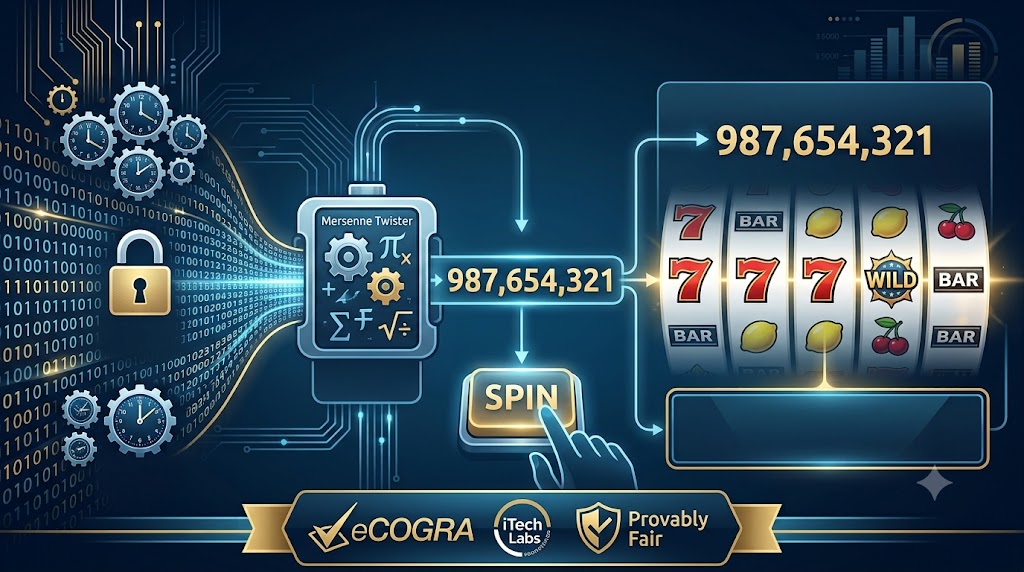
Every online slot spin comes down to one number, generated in a fraction of a millisecond, before the reels even start animating. That number decides everything. The graphics, the sound effects, the near-miss on the bonus symbol — all of it is decoration layered on top of a calculation that already happened.
This article breaks down what a random number generator actually does inside a slot machine, how testing labs like eCOGRA and iTech Labs verify it, why the “hot machine” theory doesn’t hold up mathematically, and how provably fair systems in crypto casinos take a different approach to proving the same thing: that nobody rigged the outcome.
Key Takeaways
- Online slots use pseudo-random number generators (PRNGs) — deterministic algorithms that produce statistically random-looking sequences from a seed value
- RNG output maps to a virtual reel table, which is what actually determines symbol frequency and RTP, not the visible reels
- RTP and volatility are separate variables — a slot can share an RTP with another game and still feel completely different to play
- Labs such as eCOGRA, iTech Labs, GLI, and BMM Testlabs certify RNGs using statistical test suites and source code review, not just spot checks
- “Hot” and “cold” machines, time-of-day payouts, and remote tightening are gambler’s fallacy — each spin is statistically independent
- Provably fair systems, used mainly by crypto casinos, let players verify individual outcomes using cryptographic hashes — a different trust model than third-party lab certification
The Random Number Generators inside a slot machine isn’t generating true randomness in the way a dice roll or a radioactive decay event does. It’s a pseudo-random number generator — a deterministic algorithm that starts from a seed value and produces a long sequence of numbers that pass statistical tests for randomness, even though the process itself is entirely predictable if you know the seed and the algorithm.
The seed usually comes from something with enough entropy that it’s practically unpredictable in real time: a system clock timestamp down to the microsecond, hardware noise, thermal fluctuations inside the server. From that single seed, the algorithm can generate billions of numbers in a sequence that never obviously repeats.
Most commercial slot software runs on variants of the Mersenne Twister algorithm, chosen for its extremely long period (over 2^19937 before it cycles) and uniform distribution across its output range. Older systems sometimes used linear congruential generators, which rely on modular arithmetic and are simpler but have shorter, more exploitable periods — one reason regulators pushed the industry toward more robust algorithms.
Here’s the part that surprises most players: the RNG doesn’t wait for you to hit spin. It’s running continuously, generating numbers in the background whether anyone is playing or not. The number that determines your spin’s outcome is whichever one the algorithm happens to be on at the exact millisecond you click the button. There’s no “waiting” for a good number, and there’s no way to time your spin for a better result — the number was already going to be whatever it was going to be.
From Random Number to Reel Result
A random number by itself doesn’t mean anything until it’s mapped to a result. This mapping happens through what’s called a virtual reel table.
The physical or animated reels you see on screen are a visual representation — they’re not the actual mechanism deciding what lands where. Behind them sits a table that assigns each possible RNG output to a specific combination of symbols, and critically, that table doesn’t have to weight every symbol equally.
Developers can assign a jackpot symbol a genuinely low probability of appearing (say, a 1-in-2,000 chance per reel position) while giving lower-value symbols a much higher weighting, all without changing how many symbols visually appear on the reel strip. This is why a reel can look like it has an equal shot at any symbol while the actual math behind it is heavily skewed toward smaller, more frequent wins. It’s not deception — it’s how every RTP and volatility profile gets built — but it does mean the visible reel tells you nothing about actual probability.
Random Number Generators’s Relationship to RTP and Volatility
RNG determines individual outcomes; RTP and volatility describe the long-run shape of those outcomes in aggregate.
Return to Player (RTP) is a theoretical percentage calculated across millions of simulated spins, representing the average amount returned to players over the long term. A 96% RTP slot is mathematically expected to return 96 units for every 100 wagered — not in any single session, but as the number of spins approaches infinity. The flip side of that number is the house edge: a 96% RTP slot carries a 4% house edge.
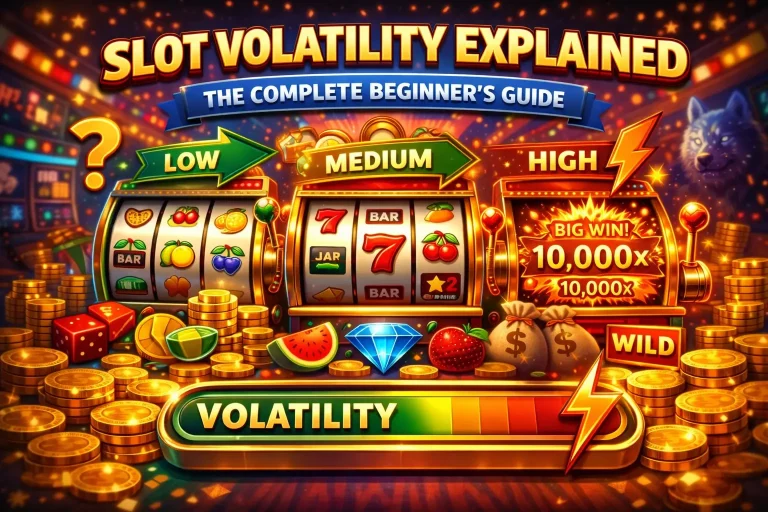
Volatility (sometimes called variance) describes how that RTP gets distributed. Two slots can share an identical 96% RTP and still play nothing alike:
| Volatility | Win Frequency | Win Size | Typical Player Experience |
|---|---|---|---|
| Low | Frequent | Small | Steady balance, few big spikes |
| Medium | Moderate | Moderate | Balanced swings |
| High | Rare | Large | Long dry stretches, occasional big hits |
Hit frequency — how often a spin produces any win, regardless of size — is a related but distinct metric from volatility. A game can have a high hit frequency and still be high volatility if most of those wins are tiny and the occasional big one is disproportionately large.
Because RTP only converges over an enormous number of spins (the law of large numbers doing its work slowly), short-term results can deviate wildly from the stated percentage. Losing on a 97% RTP game for an entire session, or hitting a big multiplier on a 92% RTP game in ten spins, is completely consistent with how the math works — it just isn’t intuitive.
Who Tests and Certifies Slot RNGs
Independent testing is what separates a licensed, auditable slot from an unverifiable one. Several labs dominate this space:
- eCOGRA — based in London, one of the earliest independent testing agencies in online gambling, auditing software for fairness and RNG integrity
- iTech Labs — Australian lab specializing in RNG evaluation and jurisdictional compliance certification
- Gaming Laboratories International (GLI) — tests gaming technology for regulators in more than 480 jurisdictions worldwide, one of the broadest reach of any testing body
- BMM Testlabs — founded in 1981, among the oldest independent labs, with a strong focus on RNG and game mathematics verification Certification isn’t a single pass/fail check. Labs run statistical test suites — including chi-square tests, serial correlation tests, and runs tests — against enormous samples of RNG output, looking for any statistical bias or pattern that shouldn’t exist in truly random-looking data. Many labs also reference standardized batteries like the NIST Statistical Test Suite or the Diehard tests as a baseline.
Beyond output testing, labs conduct source code review — examining the actual algorithm implementation for weaknesses, backdoors, or unintended bias that wouldn’t necessarily show up in a limited statistical sample. They also cross-check whether the theoretical RTP a developer claims actually matches results from large-scale simulation runs of the real game logic.
Regulators layer their own requirements on top of lab certification. The UK Gambling Commission sets technical standards operators must meet. The Malta Gaming Authority requires RNG certification from an approved lab before issuing a license. The Alderney Gambling Control Commission mandates periodic re-testing, not just a one-time check. Gibraltar’s regulator requires public RTP disclosure alongside lab-tested certification. Curaçao’s licensing framework exists too, but it’s been criticized for looser oversight compared to UK or Malta standards — worth knowing if you’re comparing where a casino is actually licensed, not just where it claims to be regulated.
One detail regulators increasingly scrutinize, tying back to the earlier section on virtual reel mapping: certifying that an RNG produces statistically sound numbers isn’t the same as verifying that the symbol weighting built on top of it actually produces the RTP a developer advertises. The more rigorous labs test both layers — the raw randomness and the mapping logic that turns it into a game result.
Common RNG Myths, Debunked
“The machine is due for a win because it hasn’t paid out in a while.” This is the gambler’s fallacy, and it misunderstands what “independent” means in a probability sense. Every spin from a properly functioning RNG is statistically independent of every spin before it. The algorithm has no memory of your last hundred losses. It’s not “due” for anything.
“Slots are programmed to pay out more at certain times of day.” No credible, licensed operator does this, and certified RNGs don’t have a time-of-day input in the first place. What looks like a “loose” hour is confirmation bias — you remember the session where you won and forget the ten where you didn’t.
“Casinos can remotely tighten or loosen a machine while people are playing.” For certified, regulated games, this isn’t how the system works. RTP and volatility are baked into the game’s math model at the software level, verified by testing labs before launch, and changing them typically requires a new build and re-certification — not a remote toggle during a live session.
“Near misses mean the machine is teasing you on purpose.” A reel stopping one symbol short of the jackpot is a random outcome like any other, not a deliberately engineered near-miss designed to keep you playing. It feels significant because human pattern recognition treats “almost” as meaningful. The RNG doesn’t.
Provably Fair Systems vs. Traditional RNG Certification
Crypto casinos introduced a different fairness model. It’s not simply a replacement for lab certification — it answers a different question.
In a provably fair system, the operator generates a secret server seed and gives the player a hashed version of it — typically via SHA-256 — before any bet is placed. The player can also supply or modify a client seed. After the outcome is revealed, the player can combine the server seed, client seed, and a nonce to independently recompute the result and confirm it matches what was shown. Because the hash was published in advance, the operator can’t have altered the server seed after seeing the player’s bet without the mismatch being detectable.
The practical difference from traditional certification is what’s being verified and by whom:
| Traditional RNG Certification | Provably Fair | |
|---|---|---|
| Who verifies | Independent lab (eCOGRA, iTech Labs, etc.) | The player, per bet |
| What’s verified | Aggregate statistical randomness across millions of spins | A single, specific outcome |
| Trust model | Trust in a third-party auditor | Mathematical proof, no auditor needed |
| RTP guarantee | Explicitly tested against the paytable | Not guaranteed — provably fair proves the outcome wasn’t tampered with, not that the house edge is fair |
That last row matters more than it might seem. A provably fair game can be perfectly verifiable and still carry a brutal house edge, because the cryptographic proof only confirms that a given seed produced a given result — it says nothing about whether the underlying paytable and symbol weighting are generous or predatory. Some blockchain-based platforms go further, using services like Chainlink VRF to generate verifiable randomness that neither the casino nor the player can manipulate, or recording hashed seeds on a public ledger for a permanent audit trail. Smart contract-based games can even execute payout logic on-chain, removing the need to trust a server-side implementation at all.
Some crypto casinos operate without traditional gambling licensing, treating provably fair technology as a substitute for regulatory oversight rather than a complement to it. That’s a real gap in consumer protection — cryptographic proof of a fair spin doesn’t cover dispute resolution, responsible gambling requirements, or the kind of licensing accountability a body like the UK Gambling Commission or Malta Gaming Authority enforces.
FAQ
Can a casino manipulate a certified RNG to make players lose more?
Not without breaking certification. Licensed operators run RNGs that were tested and locked before launch, with source code reviewed by an independent lab. Manipulating outcomes after that point would require altering certified software, which regulators check for during periodic re-audits.
Does a higher RTP mean I’ll win more often?
Not necessarily. RTP describes average return over millions of spins, not win frequency in any given session. A high-RTP, high-volatility slot can still produce long losing streaks between rare, large payouts — RTP and hit frequency are different metrics.
Is provably fair the same thing as RNG-certified?
No. Provably fair lets you verify that one specific outcome wasn’t altered, using cryptography. RNG certification is a lab confirming that thousands or millions of outcomes, in aggregate, behave statistically randomly and match the advertised RTP. They answer different questions.
Why do slots feel “hot” or “cold” if outcomes are random?
Pattern recognition. Humans naturally look for streaks and cycles even in genuinely independent random data. A run of wins or losses in a properly functioning RNG is statistically expected to happen sometimes — it doesn’t indicate a change in the machine’s underlying probability.
Do all countries require the same RNG testing standards?
No. Requirements vary significantly by jurisdiction. The UK Gambling Commission and Malta Gaming Authority both mandate lab certification and, in some cases, periodic re-testing. Other licensing bodies, such as Curaçao’s, have historically applied less rigorous oversight, which is worth checking before trusting an operator’s fairness claims at face value.
This article explains the general mechanics of RNG technology and industry-standard testing practices. It doesn’t cover the specific RNG implementation, RTP, or certification status of any individual operator — check the responsible gambling and fairness pages of a specific casino for that information.
About the author
Marcus Reed
80 articlesTrending
Sugar Rush 1000 Slot Review

What Does Double Down Mean in Blackjack
Scatter Symbols in Slots: What They Do and How to Spot Them
Exploring the World of Card Games in Casinos
![NO KYC Crypto Casino [GUIDE]](https://wolfbet.com/blog/wp-content/uploads/2025/02/no-kyc-crypto-casinos-768x439.webp)