
What Is a Flush Draw in Poker? Odds, Outs & Strategy
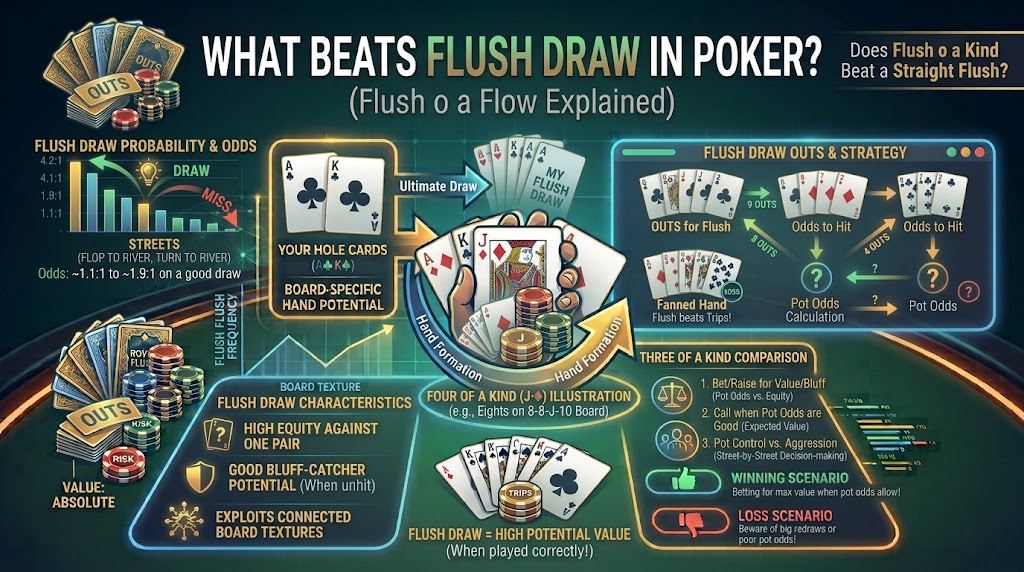
A flush draw in poker means you have four cards of the same suit and need exactly one more card of that suit to complete a flush. It’s one of the most common drawing hands in Texas Hold’em and one of the strongest – with 9 outs and approximately 35% equity from the flop, it’s a hand worth playing aggressively in the right spots.
Example: You hold A♥ 9♥ and the flop comes K♥ 7♥ 3♣. You have four hearts – a flush draw. Any of the remaining nine hearts in the deck completes your flush. If the turn brings the 4♥, you’ve made a flush. If it doesn’t, you still have one card left to hit on the river.
A flush draw is an incomplete hand – you have no made flush yet. If the river arrives and no fifth heart appears, your best hand is whatever else you have (top pair, ace-high, etc). The draw itself has no showdown value; only the completed flush does.
Flush Draw Outs: Why You Have 9
A standard flush draw gives you exactly 9 outs. Here’s the math:
- There are 13 cards of each suit in a 52-card deck
- With a flush draw, you already hold 4 cards of that suit (2 in your hand + 2 on the board in the most common scenario)
- 13 – 4 = 9 remaining cards that complete your flush
These 9 cards are your outs. Each out is a card that, if it appears on the turn or river, makes your flush.
In practice, your actual number of live outs may be slightly lower. If an opponent also holds one card of your suit, that card is no longer available – you’d have 8 effective outs. You can’t see opponents’ hole cards, so you work with 9 as the baseline and adjust based on reads and board texture.
Flush Draw Odds: Complete Probability Table
| Situation | Probability | Odds against |
|---|---|---|
| Flush draw on flop, complete on turn | 19.1% | 4.2 to 1 |
| Flush draw on turn, complete on river | 19.6% | 4.1 to 1 |
| Flush draw on flop, complete by river (turn or river) | ~35% | 1.86 to 1 |
| Backdoor flush draw on flop, complete by river | 4.2% | ~23 to 1 |
| Flopping a flush draw with 2 suited hole cards | 10.9% | ~8.2 to 1 |
| Flopping a flush outright with 2 suited hole cards | 0.84% | ~118 to 1 |
| 2 suited hole cards, make flush by river (all paths) | ~6.4% | ~15 to 1 |
The most important number: with a flush draw on the flop, you complete by the river roughly 1 in 3 times (35%). You miss about two thirds of the time. A flush draw is almost always an underdog against a made hand on the flop – but 35% equity is substantial, especially when combined with other draws or overcards.
Odds of Flopping a Flush Draw with 2 Suited Cards
Starting with two suited hole cards, the odds of flopping a flush draw are 10.9% – roughly once every 9.2 hands that you see a flop with suited cards.
The math: with 2 suited hole cards, there are 11 remaining cards of your suit in the 50 unknown cards. For a flush draw on the flop, you need exactly 2 of those 11 to appear among the 3 flop cards:
C(11,2) × C(39,1) / C(50,3) = 55 × 39 / 19,600 ≈ 10.9%Other flopping probabilities with suited hole cards:
| Outcome | Probability |
|---|---|
| Flop a flush draw (4 suited cards total) | 10.9% |
| Flop a backdoor flush draw (3 suited cards total) | ~41.6% |
| Flop a complete flush | 0.84% |
| Miss flush and flush draw entirely | ~46.7% |
You’re dealt two suited hole cards approximately 23.5% of the time in Texas Hold’em. Of those hands, just over 10% produce a flush draw on the flop. Direct flushes on the flop are very rare – less than 1 in 100 suited starting hands.
Odds of Hitting a Flush with 4 on the Flop
When you have 4 cards of the same suit on the flop (a full flush draw), here are the exact completion odds:
| Street | Cards to come | Outs | Probability |
|---|---|---|---|
| Flop → Turn only | 1 card | 9 | 9/47 = 19.1% |
| Turn → River only | 1 card | 9 | 9/46 = 19.6% |
| Flop → Turn or River | 2 cards | 9 | 1 – (38/47 × 37/46) = 34.97% |
With 4 suited cards on the flop and 4 suited cards including a hit on the flop, the odds of hitting a flush after the flop (across turn and river) are approximately 35%. If you miss the turn, your odds drop to about 19.6% – roughly 1 in 5 – for the river alone.
With 4 suited cards including hitting one on the flop (meaning you started with 1 suited hole card and 3 appeared on the board), the math is slightly different. You have 9 outs from the remaining cards of that suit, but one of your “4” came only from the board – the principles remain the same.
The Rule of 4 and 2: Quick Odds at the Table
At the table, you don’t have time for precise calculations. The Rule of 4 and 2 (also called the Rule of 2 and 4) gives fast approximations:
- On the flop (two cards to come): multiply outs by 4 to get approximate equity percentage
- On the turn (one card to come): multiply outs by 2 to get approximate equity percentage
Applied to a flush draw with 9 outs:
- Flop: 9 × 4 = 36% (exact: 34.97%)
- Turn: 9 × 2 = 18% (exact: 19.6%)
The Rule of 4 and 2 slightly overestimates at higher out counts but is accurate enough for in-game decisions. For a flush draw, it works very well – the 36% approximation is within 1% of the exact calculation.
Types of Flush Draw
Nut flush draw
You hold the highest card of the suit (the ace). If you complete the flush, you have the best possible flush. Example: A♠ 7♠ on a board of K♠ 9♠ 3♦ – you have the nut flush draw. Even if an opponent also has a spade flush draw, your ace-high flush beats theirs. Nut flush draws play aggressively: you want to build the pot because you’re drawing to the best possible flush.
Non-nut flush draw
You have a flush draw but not with the ace of that suit. Example: J♥ 8♥ on a board of A♥ 9♥ 4♣ – you have a flush draw, but if you complete it, your jack-high flush loses to any opponent holding the ace of hearts. Non-nut flush draws carry reverse implied odds: you can complete your draw and still lose to a higher flush.
Backdoor flush draw
You have three cards of the same suit (not four) and need both the turn and river to be that suit to complete the flush. Backdoor flush draws complete only 4.2% of the time from the flop. They add equity to other holdings but are rarely worth playing on their own – they’re a bonus, not a primary draw.
Combo draw with flush draw
A flush draw combined with another draw (straight draw, overcards, or a pair) gives you significantly more outs and equity. Example: 9♦ 8♦ on a board of 7♦ 6♦ 2♠ gives you a flush draw (9 outs) and an open-ended straight draw (6 additional outs after removing the overlap), totaling 15 outs and approximately 54% equity against a made hand – a clear favorite from the flop.
How to Play a Flush Draw
Semi-bluff by betting or raising
A flush draw is the prototypical semi-bluff hand. By betting or raising with a flush draw, you give yourself two ways to win: opponents fold immediately (you win the pot right now), or you complete the flush and win at showdown. Against a single opponent’s continuation bet on the flop, check-raising with a flush draw is a strong play – you have solid equity if called and fold equity if they fold.
Call when pot odds justify it
Calling with a flush draw is profitable when the pot odds offered are less than your equity. On the flop with 35% equity, you need the price to be less than 35% of the total pot (call + current pot) to break even. Example: if the pot is $60 and your opponent bets $20, you’re getting 4-to-1 pot odds and need 20% equity to call. Your flush draw at 35% has more than enough equity – the call is clear.
Don’t chase without pot odds
Blind chasing flush draws regardless of price is one of the most common and expensive leaks among recreational players. If you’re facing a pot-sized bet on the turn with one card to come, you need 33% equity to break even. Your flush draw has only 19.6% – a fold is correct unless implied odds from a loose opponent substantially improve the math.
Beware of non-nut flush draws
Completing a non-nut flush against an opponent who may hold the nut flush can be a disaster: you’ve built a large pot drawing to a losing hand. If there are three cards of a suit on the board and you hold a king-high flush draw, any opponent holding the ace of that suit dominates you. Reduce your aggression with weak flush draws, especially in large pots.
Position matters
Flush draws play better in position (acting last) than out of position. In position, you can see whether opponents check or bet before deciding whether to take a free card or raise. Out of position, you’re forced to act first each street, making flush draw play more complex and often more expensive.
Pot Odds and the Flush Draw Call
The decision to call with a flush draw comes down to comparing your equity to the pot odds you’re getting:
| Bet size (into $100 pot) | Pot odds | Equity needed | Flush draw equity (flop) | Call or fold? |
|---|---|---|---|---|
| $25 (25% pot) | 5 to 1 | 17% | 35% | Call |
| $50 (50% pot) | 3 to 1 | 25% | 35% | Call |
| $100 (pot-sized) | 2 to 1 | 33% | 35% | Marginal call |
| $150 (1.5x pot) | 1.67 to 1 | 37.5% | 35% | Fold (without implied odds) |
On the flop, flush draws can call bets up to pot-size and remain profitable. Larger bets require implied odds (the potential to win more money on later streets when you complete) to justify continuing. On the turn with 19.6% equity, the threshold drops sharply – only small-to-medium bets offer correct odds for a pure call.
FAQ
What is a flush draw in poker?
A flush draw in poker means you have four cards of the same suit and need one more card of that suit to make a flush. With a flush draw, you have 9 outs. From the flop, you’ll complete the flush by the river approximately 35% of the time.
What’s a flush draw? (whats a flush draw)
A flush draw is when you’re one card short of making a flush – you have four suited cards and need a fifth. It’s an incomplete hand with strong drawing potential. The term is used interchangeably with “four-flush” in some contexts.
What are flush draw odds?
With 9 outs on the flop, a flush draw completes by the river approximately 35% of the time (odds of 1.86 to 1). On the turn with one card left, the odds are about 19.6% (4.1 to 1). The Rule of 4 and 2 gives quick estimates: multiply 9 outs by 4 on the flop (36%) or by 2 on the turn (18%).
What are the odds of flopping a flush draw with 2 suited cards?
With two suited hole cards, you’ll flop a flush draw approximately 10.9% of the time – about once every 9.2 flops with suited cards. You’ll flop a complete flush only 0.84% of the time. A backdoor flush draw (3 suited cards) appears on roughly 41.6% of flops with suited hole cards.
What are the odds of hitting a flush with 4 on the flop?
With 4 suited cards on the flop (a complete flush draw), the odds of completing by the river are approximately 35% (34.97% exactly). The turn alone is 19.1%, and the river alone (if you miss the turn) is 19.6%. These numbers assume all 9 outs are live.
What are the odds of hitting a flush after the flop?
With a flush draw on the flop, you have approximately 35% chance of completing it on the turn or river combined. If you miss the turn, that drops to approximately 19.6% on the river. These are the standard 9-out flush draw probabilities.
What are the odds of flopping a flush draw with 2 suited cards? (odds of flopping flush draw)
The odds of flopping a flush draw (4 suited cards) with 2 suited hole cards are 10.9%, or approximately 8.2 to 1 against. Most of the time you’ll either flop a backdoor draw (3 suited) or miss the flush draw entirely.
What are the odds of flopping flush?
With two suited hole cards, the odds of flopping a complete flush are 0.84% – roughly 1 in 118. It’s rare enough that you should never count on flopping a flush; the strategic value of suited hands comes primarily from flush draw equity (the ~35% chance to complete from the flop) rather than flopped flushes.
What is a nut flush draw?
A nut flush draw is a flush draw using the ace of that suit. If completed, it’s the highest possible flush – no opponent can have a better flush of the same suit. Nut flush draws are the most valuable type and warrant the most aggressive play, since you won’t lose to a higher flush if you complete.
What is a backdoor flush draw?
A backdoor flush draw (also called a runner-runner flush draw) means you have three cards of the same suit on the flop and need both the turn and river to produce cards of that suit to complete the flush. Backdoor flush draws complete only about 4.2% of the time. They add equity to other holdings but are not worth chasing on their own.
Is a flush draw a good hand?
A flush draw is a strong drawing hand – 35% equity from the flop against most made hands makes it a hand worth playing, often aggressively as a semi-bluff. However, it’s not a made hand and has no showdown value on its own. It’s good when pot odds are favorable; it becomes expensive when chased at unfavorable prices.
Sources
- Poker Drawing Odds and Outs Explained – Upswing Poker
- Flush Draw Definition – PokerStrategy
- Ultimate Flush Draw Strategy Cheat Sheet – BlackRain79
- The Odds of Making a Flush Hand in Poker – 888poker
- What Are the Odds of a Flush with Suited Cards – MenGrip
About the author
Marcus Reed
47 articlesTrending

What WTSD Means in Poker?

What Is a Royal Flush in Poker – Full explained

Keno Games to Play: Your Ultimate Guide to Online Keno Success
Baccarat Bankroll Management
![Texas Hold’em Basics for Beginners [GUIDE]](https://wolfbet.com/blog/wp-content/uploads/2025/01/texas-holdem-e1737915543331-768x439.webp)

![7 Most Played Scratch Cards games – January [Wolfbet]](https://wolfbet.com/blog/wp-content/uploads/2025/01/top-scratch-cards-games-in-wolfbet.jpg)



![What Is House Advantage? Understanding the Math Behind Casino Edge [Guide]](https://wolfbet.com/blog/wp-content/uploads/2025/02/what-is-house-advantage-768x439.webp)