
What is sit n go Poker
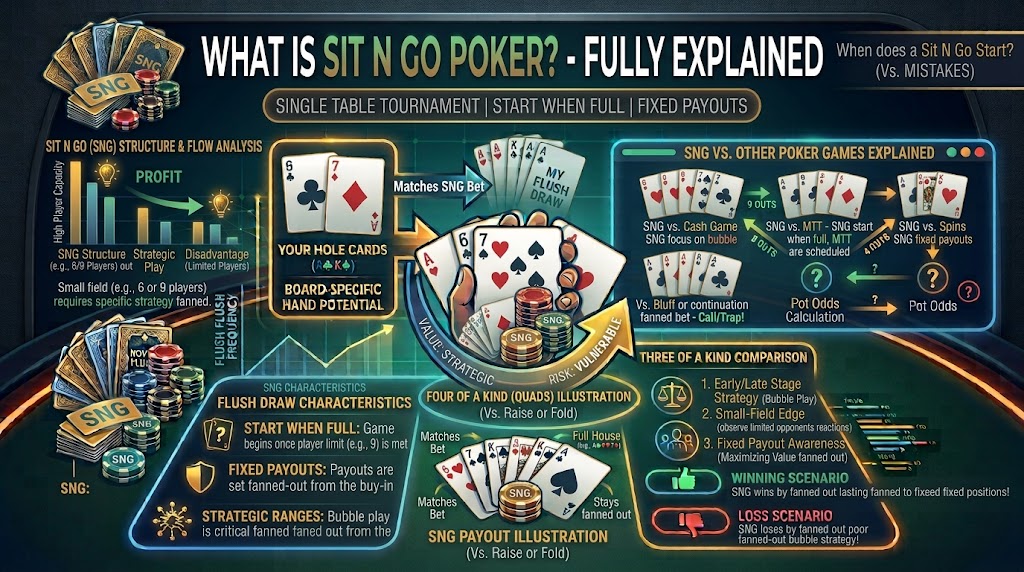
A sit and go (SNG) is a poker tournament that starts as soon as a set number of players have registered, instead of at a scheduled time. It ends when one player has all the chips, and the top finishers share a fixed prize pool. A single-table sit and go usually lasts 20 to 60 minutes.
The name says what it is: players sit down, and the game goes the moment the table is full. You will also see it written as “sit & go,” “sit-n-go,” or just SNG.
How a sit and go works
Every sit and go follows the same basic loop:
- You pay a fixed buy-in and receive a starting stack of tournament chips.
- The game starts the instant the required number of players register. There is no set start time.
- Blinds go up on a timer, so pots grow and stacks get shallower as the game runs.
- Players are knocked out as they lose their chips.
- The game ends when one player holds every chip, and the prize pool is split by finishing position.
You cannot leave with your chips the way you can in a cash game. The chips only decide where you finish, and your finish decides how much you win.
Buy-in, rake and payouts
A sit and go buy-in is usually shown as two numbers, for example $10 + $1. The first number goes into the prize pool, and the second is the fee (rake) the poker room keeps. So ten players at $10 + $1 create a $100 prize pool.
Single-table payouts depend on the number of seats:
| Table | Paid places | Typical split |
|---|---|---|
| 9 or 10 players | Top 3 | 50% / 30% / 20% |
| 6 players | Top 2 | 65% / 35% |
| Heads-up (2) | Winner | 100% |
Exact percentages vary by poker room, but this is the standard shape. The steep jump between places is what makes the last few spots so tense.
Sit and go formats
“Sit and go” is a category, not a single game. The common formats:
- Single-table (STT): 6 or 9 players at one table. The most common type and the best place to learn.
- Multi-table (MTT SNG): 18, 27, 45 or up to 180 players across several tables, starting once the field fills.
- Turbo and hyper-turbo: the same games with faster blind levels. They finish quicker and swing harder.
- Heads-up: two players, winner takes all.
- Double or nothing: the top half of the field each win double their buy-in, and everyone else gets nothing. A flat, low-variance payout.
- Spin and Go (also called Jackpot or lottery SNG): a 3-handed hyper-turbo where a random multiplier sets the prize pool before the first hand. It is the closest poker gets to a lottery ticket.
- Satellites: the prize is a seat in a larger tournament rather than cash.
Sit and go vs MTT vs cash game
Sit and gos sit between the two other main ways to play:
| Feature | Sit and go | MTT | Cash game |
|---|---|---|---|
| When it starts | When seats fill | Scheduled time | Any time you sit |
| Field size | 2 to about 180 | Hundreds to thousands | One table |
| Blinds | Rise on a timer | Rise on a timer | Fixed |
| Length | 20 to 60 min (single table) | Several hours | Open-ended |
| Leave with chips | No | No | Yes, any time |
| How you win | Finishing position | Finishing position | Chips are cash |
The fixed field and short runtime are the main draw. You know roughly how long a single-table sit and go will take, which you never do with a large MTT.
Basic sit and go strategy
A sit and go moves through clear stages, and good play changes with each one.
Early stage
Stacks are deep and blinds are tiny, so there is little to win and a lot to lose. Play tight, skip marginal spots, and let weaker players knock each other out.
Middle stage
As blinds climb, stealing them starts to matter. Open more hands in late position, put pressure on the shorter stacks, and stop waiting only for premium holdings.
Bubble and late stage
This is where sit and gos are won and lost. When you are one spot away from the money, survival can be worth more than chips, a concept called ICM (Independent Chip Model). Short stacks should move to a push-or-fold game: with around 10 to 15 big blinds or fewer, shove all-in or fold rather than making small raises you cannot defend. Applying pressure to players who are trying to survive the bubble is one of the most reliable ways to build a stack.
Why play sit and gos
Sit and gos are popular for a few practical reasons. They fit a fixed time slot, so you can play one without booking off a whole evening. They teach tournament skills such as ICM and push-fold in a fast loop, so you get many end-game situations per hour. Variance is lower than in large-field MTTs, which makes bankroll swings easier to handle.
The trade-offs: the prize pools are small compared with big MTTs, the rake on hyper-turbo and Spin and Go formats is high relative to the buy-in, and the fast structures mean a lot of your edge comes down to solid all-in decisions rather than deep postflop play.
FAQ
What does SNG stand for?
SNG stands for “sit and go,” a tournament that begins when the required number of players have registered rather than at a fixed start time.
How long does a sit and go take?
A single-table sit and go usually runs 20 to 60 minutes. Turbo and hyper-turbo versions finish faster, sometimes in under 15 minutes.
What is the difference between a sit and go and a tournament?
A sit and go is a tournament, just a small on-demand one. A standard multi-table tournament (MTT) has a scheduled start time and a large field, while a sit and go starts as soon as its seats fill and has a fixed, smaller number of players.
How many players get paid in a sit and go?
A 9 or 10-player single table usually pays the top three, and a 6-max table usually pays the top two. Double or nothing formats pay the top half of the field instead.
Can you make money playing Spin and Go?
Yes, but it is high variance and the edges are small. Winning requires a strong hyper-turbo and ICM game, a large sample of games to smooth out the swings, and enough volume to offset the relatively high rake on these formats.
About the author
Marcus Reed
61 articlesTrending

Bitcoin Casino Philippines 2026: Legal Status, Crypto Gambling and Tax Guide
![The Best Bitcoin Wallet For Online Gambling [Review]](https://wolfbet.com/blog/wp-content/uploads/2025/01/Wolf.bet-Best-Bitcoin-Wallet-for-Online-Gambling-THUMBNAIL-768x256.jpeg)
The Best Bitcoin Wallet For Online Gambling [Review]
Card Games in a Casino: Your Complete Guide to Mastering the Classics
![Racino Meaning [CASINO] [GUIDE]](https://wolfbet.com/blog/wp-content/uploads/2025/02/racino-casino-screenshot-768x439.webp)
Racino Meaning [CASINO] [GUIDE]
![How to gamble with dice? [GUIDE]](https://wolfbet.com/blog/wp-content/uploads/2025/01/casino-dice-e1737889724345-768x324.webp)


![Online Casino KYC Process: What Players Need to Know [GUIDE]](https://wolfbet.com/blog/wp-content/uploads/2025/01/getting-what-you-want-2-768x253.png)

![Fruit Million Review [BGaming]](https://wolfbet.com/blog/wp-content/uploads/2025/02/fruit-million-slot-casino-game-bgaming-768x400.jpg)