Bitcoin Casino Pakistan 2026: Legal Status, Crypto Gambling and Tax Guide
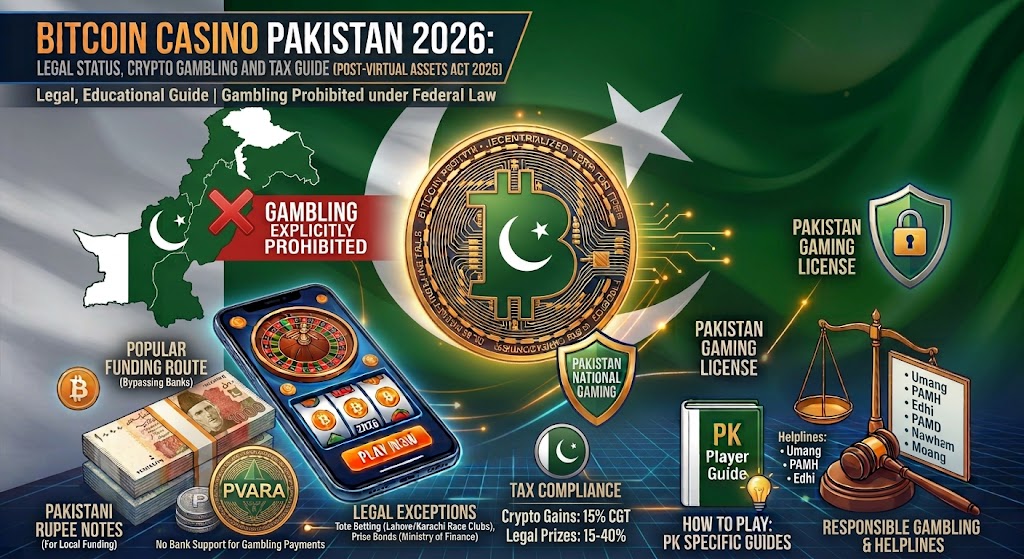
Pakistan ranked third in the world for cryptocurrency adoption in 2025, according to the Chainalysis Global Crypto Adoption Index – behind only India and the United States. Roughly 27 million Pakistanis actively use crypto. And yet gambling is explicitly prohibited under federal law, with a religious and statutory basis that goes back decades.
That contradiction sits at the heart of the bitcoin casino Pakistan question. Crypto became formally legal in 2026. Gambling did not. Understanding the difference between those two facts matters more than anything else in this guide.
Note: This article is a legal and educational guide. Gambling is prohibited in Pakistan under federal law. Wolfbet does not offer slot games to players in Pakistan. This is not legal or tax advice.
Is Bitcoin Casino Gambling Legal in Pakistan?
No. Gambling is illegal in Pakistan under the Prevention of Gambling Act 1977 (XXVIII of 1977), which applies uniformly across all four provinces – Sindh, Punjab, Khyber Pakhtunkhwa, and Balochistan. The Act criminalises operating gambling houses, keeping gaming instruments, and participating in public gambling. Penalties range from fines to imprisonment of up to one year.
The prohibition is not merely statutory – it has a religious foundation. Gambling (“maisir” or “qimar”) is explicitly forbidden in Islamic law, addressed in Surah Al-Ma’idah (5:90-91) of the Quran. Pakistan’s constitution establishes Islam as the state religion, and the 1977 Act codified this prohibition into civil law.
PECA 2016 extends this to online. The Prevention of Electronic Crimes Act (Section 37) empowers the Pakistan Telecommunication Authority (PTA) to block unlawful online content, including gambling sites and apps.
Who actually gets prosecuted?
This is the practical question, and the answer is: mostly operators and promoters, not individual players. The Cabinet Division clarified to the National Assembly in a written reply on 6 August 2025 that “taking action against the individuals involved in these activities falls outside the mandate of the PTA.” The PTA can block domains; it cannot prosecute players. Source: ARY News.
Enforcement in 2025 focused on visible promoters. YouTuber Saad ur Rehman (“Ducky Bhai”) was arrested at Lahore airport for promoting unlicensed betting apps; similar cases followed against other influencers. Lahore police reported approximately 1,500-1,600 gambling-related arrests in 2025 – largely targeting physical gaming dens and organizers, not online players.
Playing at an offshore crypto casino is not risk-free, but individual players are not the enforcement priority. The real risks are financial: no Pakistani regulator will help you dispute a withheld withdrawal from an offshore platform.
What the PTA has blocked
As of 6 August 2025, the PTA had blocked 184 gambling and betting websites and mobile apps, following complaints from the FIA, Ministry of Information and Broadcasting, and members of the public. The National Council for Crime Investigation and Analysis (NCCIA) separately declared 46 mobile betting apps illegal in August 2025, including 1xBet, Aviator Games, Dafabet, 22Bet, Bet365, and Plinko. Source: Pakistan Press Foundation.
DNS blocks are circumventable via VPN. But using a VPN to access a platform that restricts your country can void winnings – always check whether a casino explicitly accepts Pakistani players before registering.
Legal exceptions
The only legal forms of gambling in Pakistan are tote/pari-mutuel betting on horse racing at the Lahore Race Club and Karachi Race Course (permitted under the Punjab Horse-Race Betting Tax Act 1958), and prize bonds – interest-free bearer instruments with quarterly prize draws run by the Ministry of Finance. There is no national lottery.
The Crucial Distinction: Crypto is Legal, Gambling is Not
This is the single most important clarification in any bitcoin casino Pakistan guide, and most competitor articles get it wrong.
The Virtual Assets Act 2026 formally legalised cryptocurrency in Pakistan. Parliament approved it in March 2026; it received presidential assent and came into force. The State Bank of Pakistan announced the policy change on 15 April 2026, allowing banks to open accounts for entities licensed by the new PVARA (Pakistan Virtual Assets Regulatory Authority). Source: Dawn.
PVARA was initially created by presidential ordinance on 8 July 2025 and was given permanent statutory status by the 2026 Act. It licenses and supervises Virtual Asset Service Providers (VASPs), enforces AML/CFT standards, and oversees crypto exchange operations. Unlicensed crypto operations face fines up to Rs 50 million.
What the Virtual Assets Act 2026 did NOT do: it did not legalise online gambling. A Pakistani player using USDT to deposit at an offshore casino is using legal crypto for an illegal activity. The crypto transaction itself is legal; the gambling is not. This distinction is real and consequential.
The broader regulatory picture is still developing. A fatwa issued by Mufti Taqi Usmani and others in June 2026 declared purchasing goods with cryptocurrency “impermissible” under Sharia – though PVARA Chairman Bilal bin Saqib subsequently met with Mufti Usmani to discuss the matter. The question of whether crypto’s Shariah status affects its practical legality in Pakistan is unresolved. Source: Dawn.
Why Pakistanis Use Crypto for Casino Deposits
Pakistani banks do not support transfers to offshore gambling platforms. The SBP’s regulatory framework means banks applying for VASP accounts must maintain strict segregation – they certainly do not facilitate casino transactions.
Easypaisa (Telenor Microfinance) and JazzCash together have over 70 million registered mobile wallet accounts between them. They are not directly compatible with offshore casino payment systems and have been flagged in court petitions as targets of proxy gambling payment schemes.
The practical deposit flow that Pakistanis actually use:
Easypaisa or JazzCash → Binance P2P → USDT (TRC-20) → casino wallet.
You fund your Binance P2P account via Easypaisa or bank IBFT, buy USDT at market rates from verified peer sellers, then withdraw USDT to your casino wallet address. The TRC-20 (Tron) network is the standard choice: confirmations take 1-3 minutes and fees are under $1.
This works because P2P crypto trades are peer-to-peer transactions – there is no merchant payment gateway that a bank can flag. The blockchain transfer from your wallet to the casino’s deposit address routes entirely outside the banking system.
A note on VPNs: if a platform has blocked Pakistani IPs and you use a VPN to access it, most casino terms of service allow winnings to be voided on that basis. Use platforms that explicitly accept Pakistani players.
Pakistan’s Crypto Adoption: The Numbers
Pakistan’s crypto market is one of the largest in the world by active users, driven by remittances, a young mobile-first population, and limited access to traditional investment products.
The Chainalysis 2025 index notes: “Pakistan adds a fourth archetype: with a young, mobile-first population and $35 billion in remittances” as a key driver of adoption. The country moved from 9th globally in 2024 to 3rd in 2025 – a significant jump that reflects both growing grassroots adoption and institutional interest post-PVARA.
Estimates of Pakistani crypto users range widely across sources: the Finance Ministry has cited approximately 25 million users, while exchange-based estimates run higher. Treat these as approximate – the undisputed fact is that Pakistan ranks near the top globally by Chainalysis methodology.
The dominant exchanges serving the bitcoin casino Pakistan player base are Binance (accessible via P2P, not a licensed VASP) and local platforms moving toward PVARA licensing. USDT is the most commonly transacted asset for remittance and commerce purposes.
Pakistan also receives one of the world’s largest remittance flows. The State Bank of Pakistan reported record inflows of $41.6 billion in FY2025-26 – up 8.6% from $38.3 billion the prior year – with Saudi Arabia, UAE, UK and EU as the top sources. This diaspora connection means many Pakistanis living abroad have easier access to international payment systems and crypto exchanges than those inside the country.
Tax on Gambling Winnings and Crypto in Pakistan
Gambling winnings from legal activities (horse racing, prize bonds) are subject to withholding tax. Under the Income Tax Ordinance 2001, Section 156 (“Prizes and winnings”), prize bond and crossword winnings face 15% withholding for filers and 30% for non-filers; raffle, lottery and quiz prizes face 20% for filers and 40% for non-filers, as a final tax. There is no specific regime for offshore gambling winnings, but Pakistani tax residents are in principle required to declare worldwide income.
Cryptocurrency is treated as a capital asset. Post the Virtual Assets Act 2026, the FBR has aligned toward a flat 15% capital gains tax on crypto gains, mirroring the stock-market CGT structure. Mining income is assessed as regular income at progressive rates of 5-35%. PVARA-licensed exchanges are expected to report transaction data to the FBR under emerging CARF-aligned requirements from July 2026 onward. These details are still being operationalised – the framework is new.
The interaction of crypto tax and gambling is legally untested in Pakistan. Converting USDT winnings from a casino back to PKR on a P2P marketplace is a disposal event that could trigger CGT on any price appreciation. Keep records.
(General information only. Consult a registered tax practitioner for your situation.)
Cricket Betting and the Grey Market
Cricket dominates Pakistani sports culture, and it sits at the centre of the bitcoin gambling Pakistan grey market, and cricket betting is the dominant form of unofficial gambling in the country. Underground bookie networks have operated since the 1990s, and the Pakistan Super League generates significant offshore betting volume.
Pakistan has been central to match-fixing scandals – most famously the 2010 Lord’s spot-fixing case, which resulted in UK criminal convictions for three Pakistani players. The PCB has since banned gambling sponsorships (2024) and the government has directed regulatory bodies not to enter contracts with gambling-adjacent companies.
Despite this, cricket betting apps were specifically targeted in the NCCIA’s August 2025 crackdown, with dozens of apps declared illegal. The grey market persists because the demand is deep and enforcement against individual bettors is minimal.
Responsible Gambling
Problem gambling is a recognised harm regardless of legal status. If gambling is affecting your life:
- Umang helpline (Pakistan): 0317-4288665 – mental health support and counselling referrals
- Pakistan Association for Mental Health (PAMH): pamh.org.pk
- Edhi Foundation: edhi.org – 115 – broader welfare and crisis support
Gambling platforms operating offshore are under no obligation to implement Pakistani self-exclusion programmes or respond to Pakistani regulatory complaints. Any limits or self-exclusion tools you set must be done through the casino itself.
FAQ
Is bitcoin casino gambling legal in Pakistan? No. The Prevention of Gambling Act 1977 prohibits gambling across all Pakistani provinces. Online gambling is addressed under PECA 2016 via PTA blocking powers. No Pakistani law explicitly criminalises individual players at offshore platforms, but gambling itself is illegal and there is no consumer protection for players at unlicensed offshore sites.
Is crypto legal in Pakistan? Yes, since the Virtual Assets Act 2026. The SBP formally announced the policy change on 15 April 2026, allowing banks to open accounts for PVARA-licensed crypto service providers. Crypto is legal to hold and trade as an asset. It is not legal tender.
Does crypto legality make online gambling legal? No. These are separate legal questions. Using USDT to deposit at an offshore casino uses legal crypto for an illegal activity. The Virtual Assets Act 2026 did not address gambling.
Why do Pakistani banks decline casino transactions? Banks do not facilitate gambling transactions under SBP regulatory guidelines. The practical route for Pakistani players is Easypaisa or JazzCash to Binance P2P to USDT, then blockchain transfer to the casino – bypassing the banking system entirely.
Has the PTA blocked gambling sites? Yes. As of 6 August 2025, the PTA had blocked 184 gambling and betting websites and mobile apps, per a written Cabinet Division reply to the National Assembly. Individual players are not within PTA’s enforcement mandate.
Do I pay tax on crypto casino winnings in Pakistan? Pakistani law taxes prize winnings from legal sources (Section 156) and crypto gains (15% CGT under the post-2026 framework). Offshore gambling winnings have no specific regime but may fall under general foreign income declaration obligations. The interaction of crypto CGT and gambling winnings is legally untested. Keep records of all transactions.
How does Pakistan rank in global crypto adoption? Third globally in the 2025 Chainalysis Global Crypto Adoption Index, published 2 September 2025, behind India and the United States.
Last updated August 2026. Pakistan’s crypto regulatory framework under PVARA is actively developing. The gambling law situation is stable but legislative monitoring is advisable. Check back for updates.
This article is for educational purposes only. Wolfbet does not offer slot games to players in Pakistan. This is not legal or tax advice. Consult a licensed attorney or tax practitioner for advice specific to your situation.
About the author
Marcus Reed
81 articlesTrending
What Is Rummy in Blackjack?

How to Manually Verify Your Crypto Dice Rolls

Lucky Ducky slot Review

Cascading Reels: The Slot Mechanic That Keeps Wins Rolling
![Great Rhino Megaways Slot Review [Pragmatic Play]](https://wolfbet.com/blog/wp-content/uploads/2025/02/great-rhino-megaways-casino-game-768x434.jpg)


![Fruit Million Review [BGaming]](https://wolfbet.com/blog/wp-content/uploads/2025/02/fruit-million-slot-casino-game-bgaming-768x400.jpg)