What does UTG mean in poker?
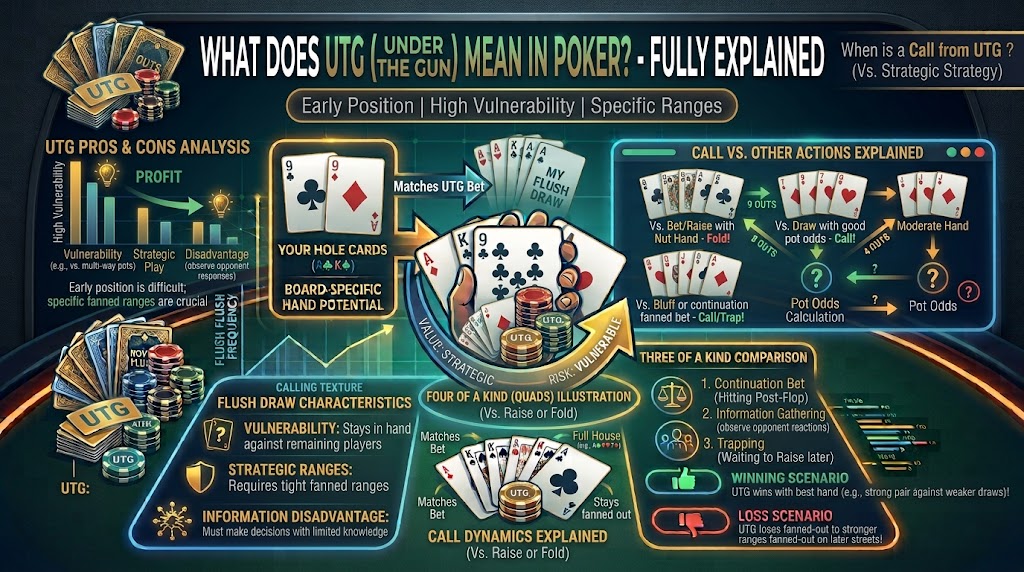
UTG stands for “under the gun.” It is the seat that acts first in the preflop betting round, sitting directly to the left of the big blind. When you are UTG, everyone else at the table acts after you, which makes it the hardest position to play well.
That is the short answer. The rest of this page covers where the seat sits at different table sizes, where the name comes from, and how to play it without bleeding chips.
Where UTG sits at the table
Poker positions are defined by the button and the blinds. The small blind and big blind post forced bets before the deal, and the first player to act after them preflop is under the gun.
In a full 9-handed game, the positions in order of who acts first preflop look like this:
| Order | Position | Group |
|---|---|---|
| 1 | UTG | Early |
| 2 | UTG+1 | Early |
| 3 | UTG+2 | Early |
| 4 | LJ (lojack) | Middle |
| 5 | HJ (hijack) | Middle |
| 6 | CO (cutoff) | Late |
| 7 | BTN (button) | Late |
| 8 | SB (small blind) | Blinds |
| 9 | BB (big blind) | Blinds |
UTG, UTG+1 and UTG+2 make up early position. The “+1” and “+2” just count seats to the left of the original under-the-gun seat, so UTG+1 acts second and UTG+2 acts third.
The number of early seats shrinks as the table gets smaller:
| Table size | Early-position seats |
|---|---|
| 9-handed | UTG, UTG+1, UTG+2 |
| 8-handed | UTG, UTG+1 |
| 6-handed | UTG only |
| Heads-up | none (no UTG) |
In 6-max, UTG is the only early seat, and it lines up roughly with the lojack in a full-ring game. Heads-up has no under the gun at all, because with two players the button posts the small blind and acts first preflop.
If you have seen labels like “UTG7” or “UTG8” in a solver or a tracker, that is just shorthand for the under-the-gun seat at a 7- or 8-handed table. Same seat, different notation.
Why is it called “under the gun”?
The name comes from the pressure of acting first. You have to decide before anyone else has shown any intent, with no read on what the players behind you will do. “Under the gun” already meant being under time pressure or forced to move, and poker borrowed it for the seat that has to act before the whole table.
There is nothing physical about it. The term describes the spot, not a rule.
How the action works from UTG
Preflop, the under-the-gun player acts first and picks one of three options: fold, call the big blind, or raise. Action then moves clockwise around the table.
Postflop, the order changes. On the flop, turn and river, action starts with the small blind, or the first remaining player to the button’s left. So UTG is first to act preflop but acts later on each street after the flop. That does not help much, since you are still stuck acting ahead of most of the field for the rest of the hand.
Why UTG is the hardest seat
Position is information, and UTG has the least of it. Every player behind you gets to see what you do before they decide. If you open, anyone left to act can re-raise with a stronger range, and you have to respond first without knowing who really has a hand.
Two things follow from that:
- You will play more pots out of position, which is where most money is lost.
- Your marginal hands lose value, because more players are left who can turn up with something better.
AQ looks great until you remember that eight or nine players can still show up with AK or a big pair. KJ offsuit is worse: easy to dominate and awkward to play when someone raises behind you. These are the hands that quietly drain a stack from early position.
Which hands to play from UTG
The rule is easy to say and hard to follow: open a tight, strong range and fold everything marginal.
A safe baseline for a full-ring game, around 10 to 12 percent of hands:
- Pairs: 77+
- Suited: ATs+, KQs, KJs, QJs, JTs, T9s
- Offsuit: AQo+
In a live $1/$2 game where a lot of players call and pots go multiway, tighten further, closer to 8 to 10 percent. Cut the weaker offsuit broadways and the speculative suited aces. In online 6-max you can open a bit wider, since fewer players are left behind you and folding is more common.
If you remember one thing: a hand that cannot handle a re-raise does not belong in your UTG opening range.
Should you limp or raise UTG?
Raise. Open-limping from under the gun invites the whole table in behind you, gives up any chance of winning the pot before the flop, and leaves you playing a multiway pot out of position with no initiative. A standard raise, around 2.5x to 3x online and often larger live, sets a stronger tone and gives your hand a way to win without a showdown. Limping UTG is one of the clearest beginner tells there is.
Adjusting UTG play
In cash games
Stacks are deep and blinds stay flat, so there is no reason to loosen. Keep the same disciplined range all session and wait for better spots in later positions.
In tournaments
Rising blinds change the math. With a deep stack, play it like a cash game. As your stack falls to roughly 15 to 25 big blinds, open a tighter set of hands that are happy to get all-in, and drop the speculative holdings that need deep stacks to pay off. Near the money, ICM pressure tightens the range even more.
With a straddle
A straddle is a blind raise, usually double the big blind, posted before the deal. It pushes the action one seat further and shrinks effective stacks measured in big blinds. When a straddle is on, tighten up.
Common UTG mistakes
- Opening too many hands out of boredom or a want for action.
- Overrating hands like AJo or 88 that play fine in late position but poorly against a full table.
- Firing a continuation bet on every flop after an early-position raise, as if the raise alone won the pot.
- Limping instead of raising, then folding to the raise you invited.
UTG and the other poker positions
UTG is one label in a full set, and knowing the rest helps you read where the action is coming from:
- UTG, UTG+1 and UTG+2 are the early seats with the tightest ranges.
- The lojack (LJ) is the first middle-position seat.
- The hijack (HJ) sits in middle position, one seat to the right of the cutoff.
- The cutoff (CO) is late position and can open a wide range.
- The button (BTN) is the best seat, acts last after the flop, and plays the widest range.
- The small blind and big blind post forced bets and act first postflop.
The further left of UTG you sit, the more players have already folded by the time it is your turn, and the more hands you can play at a profit.
FAQ
Is UTG a good position in poker?
No. It is the worst seat at the table, because you act first preflop with no information and usually end up playing the hand out of position. You can still make money from it by opening a tight, strong range.
What does UTG+1 mean?
UTG+1 is the seat directly to the left of under the gun, the second player to act preflop. UTG+2 is the next one along. All three are early position.
What hands should you fold from UTG?
Fold weak aces (A9o and below), most offsuit broadways like KJo and QTo, small pairs in tough live games, and any hand that cannot comfortably continue against a re-raise.
Does UTG exist in every poker game?
It exists in flop games with blinds, such as Texas hold’em and Omaha. Heads-up has no UTG. Games that use a bring-in instead of blinds, like stud, use different position terms.
Why do solvers say UTG8 or UTG7?
That is notation for the under-the-gun seat at an 8-handed or 7-handed table. It is the same first-to-act seat, just labeled with the table size.
About the author
Marcus Reed
81 articlesTrending

RNG definition and meaning
Craps vs Sic Bo: Which Dice Game Should You Play?
What is nit in Poker – Full Explained
Baccarat Odds Explained: Player vs Banker vs Tie
![Baccarat Basics for Beginners [GUIDE]](https://wolfbet.com/blog/wp-content/uploads/2025/01/baccarat-beginners-e1737907885481-768x439.webp)