
What Is a Bluff Catcher in Poker
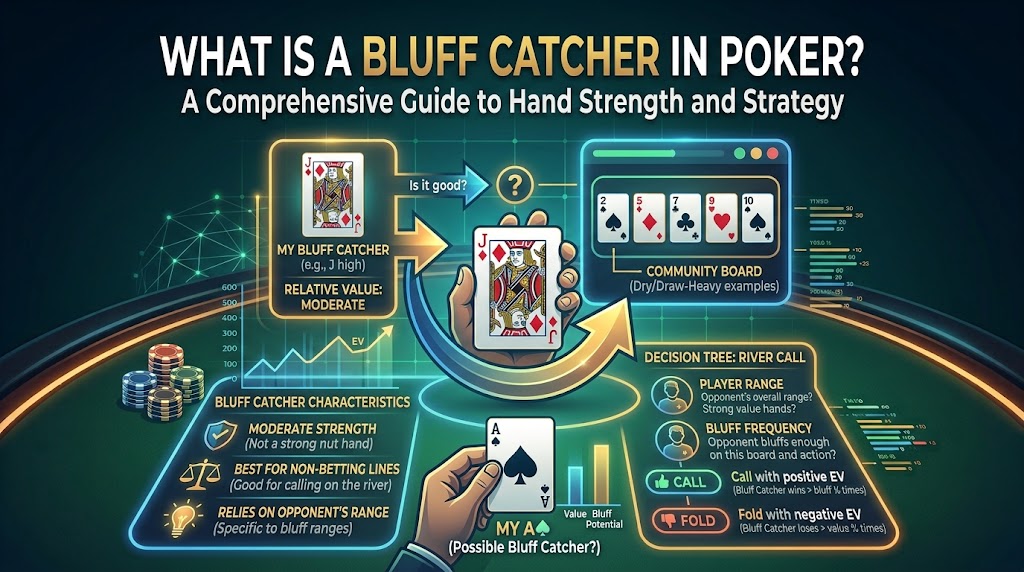
A bluff catcher is a hand that can beat your opponent’s bluffs but loses to everything in their value range. It sits in the middle: not strong enough to bet for value, not weak enough to be a clear fold. The only way a bluff catcher wins at showdown is if the opponent was bluffing.
The bluff catcher meaning hinges on the relationship between two ranges: the range you hold and the range your opponent is betting with. Your hand becomes a bluff catcher specifically when the opponent’s betting range divides into value hands that beat you and bluffs that you beat – with nothing in between. That structure is called a polarized range, and bluff catching decisions almost always arise against it.
Bluff catchers most often appear on the river, because that’s where ranges are most polarized and where the decision to call or fold is final. You can’t improve on the river – what you have is what you have. The only question left is whether calling is profitable given how often the opponent is bluffing.
Bluff Catcher Examples
Example 1: Ace-high on a missed draw board
You hold A♣ 7♣. The board runs out K♦ 9♠ 5♥ 2♦ J♣. No flush completed, no obvious straight. Your opponent fires a big river bet. Your A♣ 7♣ has no pair and no draw – but ace-high beats any hand your opponent is bluffing with (missed flush draws, missed gutshots, hands giving up). If their range is polarized between K-x or better (value) and missed draws (bluffs), your ace-high is a bluff catcher.
Example 2: Second pair on an overbet
You hold Q♥ J♦ on a board of K♠ Q♦ 8♣ 3♥ 2♠. You have second pair, decent kicker. The opponent shoves the river for 150% pot. A polarized overbet range typically contains the nuts (K-K, K-Q, sets) and bluffs (missed draws, air). Your Q-J beats the bluffs, loses to the value. It’s a bluff catcher – the question is whether the overbet frequency of bluffs justifies the call.
Example 3: Bottom pair facing a river barrel
You hold 6♠ 5♠ on a board of A♦ 9♣ 6♥ 2♣ T♠. You have bottom pair with no draws. The opponent bets the river after barreling twice. Bottom pair beats any bluff the opponent holds, but loses to any pair of aces, nines, or tens in their value range. Whether to call depends on how often they’re bluffing that line.
Note that any hand – including king-high or jack-high – can be a bluff catcher in the right spot. The term describes the role of the hand in the specific situation, not an absolute hand strength.
Bluff Catchers and Polarized Ranges
Understanding bluff catchers requires understanding polarized ranges. When an opponent bets large on the river, their range tends to polarize into two buckets:
- Value hands: Strong holdings that want to get called – sets, straights, flushes, two pair, top pair top kicker.
- Bluffs: Hands with no showdown value that can only win by making you fold – missed draws, air, underpairs that gave up.
A polarized range contains few medium-strength hands. If an opponent bets large with only strong hands and bluffs, medium-strength hands that beat the bluffs but lose to the value hands are bluff catchers.
By contrast, if an opponent bets small with a merged range (lots of medium-strength hands), bluff catching becomes less relevant because the range isn’t cleanly split. Bluff catchers matter most against aggressive large-bet or overbet lines on the river.
The Pot Odds Math Behind Bluff Catching
Calling with a bluff catcher is profitable only when the opponent is bluffing more often than the pot odds require. The calculation is straightforward:
Break-even bluff frequency = Bet size ÷ (Pot + 2 × Bet size)
Working through common bet sizes against a 100-chip pot:
| Bet size | You call | Total pot if you call | Break-even bluff % |
|---|---|---|---|
| 33% pot (33 chips) | 33 chips | 166 chips | 20% |
| 50% pot (50 chips) | 50 chips | 200 chips | 25% |
| 75% pot (75 chips) | 75 chips | 250 chips | 30% |
| 100% pot (100 chips) | 100 chips | 300 chips | 33% |
| 150% pot (150 chips) | 150 chips | 400 chips | 37.5% |
| 200% pot (200 chips) | 200 chips | 500 chips | 40% |
A bluff catcher has 100% equity against bluffs and 0% equity against value hands. So your “equity” against the opponent’s full range equals exactly the percentage of that range that’s bluffs. If the opponent is bluffing more than the break-even percentage for their bet size, calling is profitable. If they’re bluffing less, folding is correct.
Example: Opponent bets 75% pot on the river. Break-even bluff frequency is 30%. If you estimate they’re bluffing 40% of the time on this line, the call is profitable. If you estimate they’re bluffing 20% of the time, fold.
When to Call with a Bluff Catcher
Several conditions favor calling with a bluff catcher:
Opponent is aggressive and bluffs frequently
Against players with high aggression stats, wide bluffing ranges, or a known tendency to fire draws that miss, bluff catchers become more valuable. Their bluffing frequency is more likely to exceed the break-even threshold.
The board favors missed draws
When a flush draw or straight draw misses on the river, aggressive opponents often turn those missed draws into bluffs. A river card that completes nothing is a natural bluffing card for players who were drawing. If the opponent bet flop and turn with draw-heavy hands, and the river blanks, their range contains more bluffs.
The betting line is inconsistent with value
If the opponent’s line doesn’t tell a coherent value story – check-raising the flop, calling the turn, betting big on the river – and the board doesn’t connect cleanly with strong holdings, their range is more likely to contain bluffs than a straightforward line would suggest.
You have position
Calling in position is generally more comfortable because you’ve seen all of the opponent’s actions before acting. Out of position, you’re acting first on all streets, which means you face more uncertainty when deciding whether to call a river bet.
Bet sizing is large
Paradoxically, large bets can be easier to call with bluff catchers than small bets. Large bets polarize ranges more strongly – they’re usually strong value or bluffs, with less medium-strength filler. A 150% pot overbet is often the nuts or a bluff. A 30% pot small bet is more likely to be a merged range of medium-strength hands that actually beat your bluff catcher.
When to Fold with a Bluff Catcher
Folding is correct when the opponent’s bluffing frequency is too low to justify the call:
Opponent is straightforward or passive
Against players who rarely bluff – nits, passive regulars, ABC players – the bluffing frequency in their range is low. A large river bet from a straightforward player usually means a strong hand. The break-even bluff threshold isn’t being met, so folding is correct even with a hand that beats bluffs.
The board fully connects with opponent’s value range
If the turn and river cards complete the draws the opponent was representing, their range is now heavily weighted toward value. Fewer bluffs remain. If a flush completes on the river and the opponent was representing a flush draw the whole way, they got there most of the time.
You block the bluffs, not the value
Blockers matter. If you hold a card that the opponent would need to bluff (for example, you hold the A♣ and the flush draw was clubs), your call blocks their most likely bluffs and makes the call less profitable. Conversely, if you block value hands and not bluffs, calling becomes better.
ICM pressure in tournaments
In tournaments near pay jumps or at the final table, losing a bluff-catching call can cost more in tournament equity than the pot is worth. The break-even math changes when stack preservation has value beyond the chip count.
How Blockers Affect Bluff Catching
Blockers are cards in your hand that reduce the number of combinations the opponent can hold. In bluff-catching spots, blockers influence the call in two directions:
Good blockers to hold (for calling): Cards that block the opponent’s value range and leave more bluffs in their range. If the opponent’s value is sets of kings and you hold a king, there are fewer kings available for them to hold – their range has relatively more bluffs.
Bad blockers to hold (hurts the call): Cards that reduce the opponent’s bluffing combinations. If the opponent would bluff with missed flush draws and you hold two cards of that suit, you’ve removed flush draw combinations from their range – fewer bluffs means the call is less attractive.
Modern GTO solvers weight blocker effects heavily in bluff selection and bluff-catching decisions. Holding cards that block value hands while leaving bluff combinations intact is the ideal bluff-catching position.
The GTO Perspective on Bluff Catchers
In game theory optimal play, a perfectly balanced opponent bets bluffs at exactly the frequency that makes you indifferent between calling and folding with a bluff catcher. If they bluff at exactly the right rate for their bet size, your expected value of calling equals your expected value of folding – both are zero profit in the long run.
This leads to an important insight from GTO Wizard: bluff catching is not a significant source of profit in most situations. Against a well-constructed betting range, it’s roughly a break-even proposition. The real money in poker comes from value betting, not from catching bluffs.
In practice, no opponent bets at perfectly balanced frequencies. Exploit the imbalances:
- Opponents who bluff too often: call more frequently with bluff catchers
- Opponents who bluff too rarely: fold more frequently, even with hands that beat bluffs
The GTO baseline tells you what a balanced opponent would do. Your job at the table is to identify which direction your specific opponent deviates and adjust accordingly.
Common Bluff Catching Mistakes
Calling because you “can’t let them bluff you”
Ego-driven calls are one of the most expensive leaks in poker. If the math doesn’t support calling – if the opponent’s bluffing frequency is too low given their bet size – folding is correct regardless of whether it feels like being pushed around. Bluff catching is a mathematical decision, not a statement about toughness.
Calling with blockers to the bluffs
Holding cards that reduce the number of bluffs in the opponent’s range makes calls worse, not better. Many players call because they “have a good hand” without considering whether their specific hand blocks bluffs or value. Blocking bluffs means the opponent is more likely to have value – the opposite of what you want.
Bluff catching against players who don’t bluff
A bluff catcher is worthless against an opponent whose river betting range contains almost no bluffs. Straightforward players, passive recreational players, and tight regulars often bet the river only with strong value hands. Calling their river bets with second pair or bottom pair is a consistent losing play.
Treating all bet sizes the same
A 33% pot bet requires the opponent to be bluffing only 20% of the time for a call to break even. A pot-sized bet requires 33% bluffs. These are very different thresholds. Calling large bets at the same frequency as small bets – or folding small bets as often as large ones – is a significant strategic error.
Ignoring the betting line
A river bet doesn’t exist in isolation. The full sequence of actions – who bet the flop, who called the turn, what the board texture looks like – determines what range is being bet. A river bet after a check-raise on the flop and a call on the turn tells a different story than a river bet after two checks.
Tournaments vs Cash Games
Bluff catching is generally more complex in tournaments than in cash games because of ICM (Independent Chip Model) pressure. In a cash game, chips are chips – a call that breaks even in chip EV is correct. In a tournament, losing chips costs more than gaining the same number of chips profits, especially near pay jumps or at the final table.
Tournament adjustments for bluff catching:
- Near pay jumps, fold bluff catchers more than pure chip math suggests
- On the bubble, opponents bluff less (they want to survive), so call less
- Short-stacked opponents may bluff more out of desperation – adjust upward
- Deep-stack cash game bluff-catching math doesn’t transfer directly to 20-30bb tournament spots
In cash games with no ICM pressure, pure pot odds and opponent bluffing frequency determine the decision. In tournaments, factor in stack sizes, payouts, and the relative cost of elimination at each stage.
FAQ
What is a bluff catcher in poker?
A bluff catcher is a hand that beats your opponent’s bluffs but loses to all their value hands. It’s not strong enough to bet for value itself, but it has showdown value against a bluffing range. The term describes a hand’s role in a specific situation – even ace-high or king-high can be a bluff catcher in the right spot.
What does bluff catcher mean?
Bluff catcher means a hand positioned exactly in the middle of the opponent’s betting range – beating the bluffs at the bottom of that range, losing to the value hands at the top. Calling a bet with a bluff catcher is called bluff catching. The decision hinges on whether the opponent is bluffing often enough to make the call profitable given the pot odds.
When should you call with a bluff catcher?
Call when you estimate the opponent is bluffing more often than the pot odds require. For a pot-sized bet, the break-even bluff frequency is 33% – if you believe they’re bluffing more than a third of the time, calling is profitable. The call also becomes more attractive against aggressive opponents, on boards with many missed draws, and when you hold blockers to value hands rather than bluffs.
What is the difference between a bluff catcher and a value hand?
A value hand beats most of the opponent’s range and can be bet for value to get called by worse hands. A bluff catcher only beats the bluffs in the opponent’s range – it loses to everything they’d bet for value. A value hand wants to build the pot; a bluff catcher only calls when the opponent bets, and only profits if they were bluffing.
Can you bluff with a bluff catcher?
No – the point of a bluff catcher is to call, not to bet. If you bet a bluff catcher, you’re turning it into a bluff yourself, which only makes sense if you can get better hands to fold. In most situations, bluff catchers are called-with, not bet.
What is a polarized range in poker?
A polarized range contains mostly strong value hands and bluffs, with few medium-strength hands in between. When an opponent has a polarized range, your medium-strength hands become bluff catchers – they lose to the strong value hands and beat only the bluffs. Polarized ranges are most common with large river bets and overbets.
How do pot odds affect bluff catching?
Pot odds determine the minimum bluffing frequency required to make a call profitable. Against a 33% pot bet, the opponent needs to be bluffing 20% of the time for you to break even. Against a pot-sized bet, they need to bluff 33% of the time. Larger bets require higher bluffing frequencies to justify a call, but they also tend to indicate more polarized ranges where bluffs are more common.
Does a bluff catcher work against all opponents?
No. Against opponents who rarely or never bluff, a bluff catcher is worthless – you’re calling down with a hand that only beats bluffs, against a player who doesn’t have bluffs in their betting range. Bluff catching is most effective against aggressive players with wide bluffing ranges. Against straightforward or passive players, fold bluff catchers and save those chips.
Sources
- What is a Bluff Catcher and When Should You Bluff Catch – Upswing Poker
- The Art of Bluff Catching – GTO Wizard
- Perfect GTO Bluffing and Bluff Catchers – SplitSuit Poker
About the author
Marcus Reed
80 articlesTrending
![Book Of Cats Megaways slot Review [BGaming]](https://wolfbet.com/blog/wp-content/uploads/2025/02/book-of-cats-megaways-casino-online-game-gambling-768x427.jpg)
Book Of Cats Megaways slot Review [BGaming]

What Are Multipliers in Slot Games? Boosting Your Wins

What Is Autoplay in Online Casino Games? Pros and Cons
How Many Slots on a Roulette Wheel?



![Doggy Riches Megaways Review [Red Tiger]](https://wolfbet.com/blog/wp-content/uploads/2025/02/doggy-riches-megaways-slot-review-casino-game-768x421.jpg)
![Casino Reels – Definition and Meaning [GUIDE]](https://wolfbet.com/blog/wp-content/uploads/2025/02/casino-reels-768x768.webp)
![3 Best Strategies to Win at Bitcoin Dice Explained [Guide]](https://wolfbet.com/blog/wp-content/uploads/2025/01/bitcoin-dice-768x402.jpg)