Craps for Complete Beginners: Table Layout and Basic Bets Explained
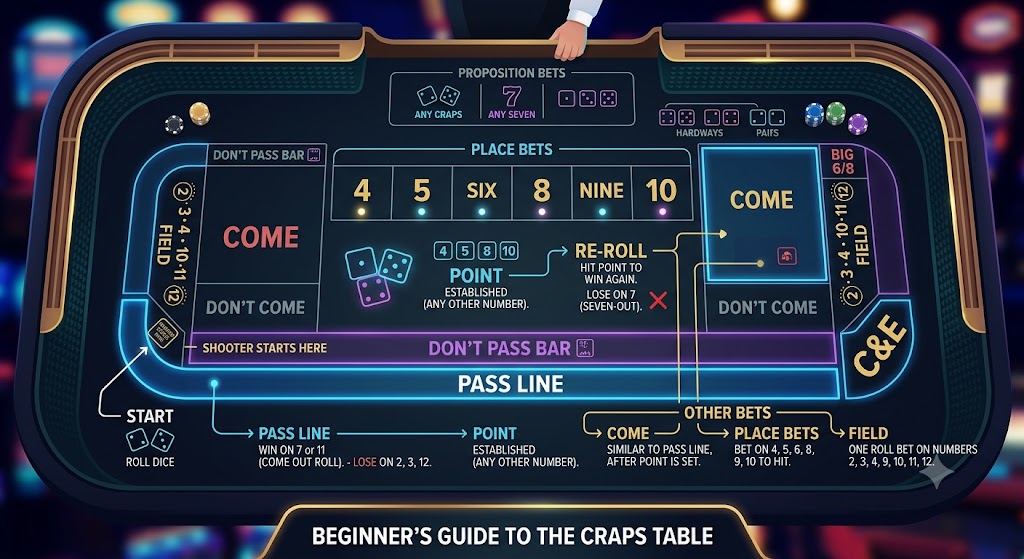
A craps table looks like a cockpit. Numbers everywhere, dealers calling out things in half-code, chips flying between hands you can’t quite follow. Most of that felt is decoration. Once you know what five or six sections actually mean, the rest of the table is just repetition.
This guide walks through the layout section by section, defines every bet you’ll actually use, and gives you the house edge for each one — the number that tells you which bets are worth making and which ones exist to separate tourists from their money.
Key Takeaways
- A craps table has two mirrored betting areas (one on each side) plus a shared center for proposition bets — you only need to understand one side
- The pass line and don’t pass bar are the foundation of the game; almost everyone at the table is on one or the other
- Odds bets, placed behind a pass or don’t pass wager, carry a 0% house edge — the only bet in the casino where the house has no mathematical advantage
- House edge ranges from 1.36% (don’t pass) to 16.67% (any seven) — knowing this list is the entire beginner strategy
- The come-out roll starts every round and determines whether a point gets established
- A printable reference table at the end of this guide covers every bet, its payout, and its house edge in one place
How a Round of Craps Works
Every round starts with a come-out roll — the shooter’s first throw. Two outcomes are possible:
- The shooter rolls a 7 or 11: pass line bets win immediately, don’t pass bets lose. The round ends and a new come-out roll begins.
- The shooter rolls a 2, 3, or 12 (“craps”): pass line bets lose immediately, don’t pass bets win (except on 12, which is usually a push — some tables use 2 as the push number instead).
- The shooter rolls a 4, 5, 6, 8, 9, or 10: that number becomes “the point.” A dealer places a marker puck on it, and the shooter keeps rolling until either the point comes up again (pass line wins) or a 7 shows up first (pass line loses, called “sevening out”).
That’s the entire skeleton of the game. Every other bet on the table is a variation, a side wager, or a way to bet on a specific number without becoming the shooter.
The Table Layout, Section by Section
A standard craps table runs about 12 feet long and 4 feet wide, with a raised rim for chips and drinks. The layout is symmetrical — identical betting areas mirrored on both long sides of the table, plus one shared center strip.
Pass line: the curved band that runs along the outer edge of the table, closest to the players. This is where most beginners place their first bet.
Don’t pass bar: a smaller rectangular strip just above the pass line, on the player’s side. Bets here go against the shooter.
Field: a large boxed section printed with the numbers 2, 3, 4, 9, 10, 11, 12. One-roll bet, resolved on the very next throw.
Come and don’t come: large boxed areas positioned between the field and the box numbers. These work exactly like pass/don’t pass, except a new “come” bet can be placed on any roll after the point is established, effectively letting you start your own personal point.
Box numbers (place bet row): the row of numbered boxes reading 4, 5, 6, 8, 9, 10, positioned above the come area. This is where place, buy, and lay bets go.
Center proposition area: the strip running down the middle of the table, shared by both sides, staffed by the stickperson. This holds hardways, any seven, any craps, horn bets, and other one-roll or multi-roll side bets.
Big 6 / Big 8: on some (mostly older) tables, a separate boxed section near the corners lets you bet on 6 or 8 rolling before a 7. Modern tables usually fold this into the place bet row instead, since place bets on 6 and 8 pay better odds for the same wager.
Line Bets: Pass, Don’t Pass, Come, Don’t Come
Pass line — you’re betting the shooter rolls a 7 or 11 on the come-out, or hits the point before a 7. Even-money payout. House edge: 1.41%.
Don’t pass bar — the mirror image. You win if the shooter rolls 2 or 3 on the come-out (12 is typically a push), and you win if a 7 shows before the point repeats. Because 12 is a push rather than a win, the don’t pass house edge comes out slightly lower than pass line. House edge: 1.36%.
Come — functions identically to a pass line bet, but you can place it on any roll after the point is already established. The very next roll acts as your personal come-out roll: 7 or 11 wins, 2/3/12 loses, anything else becomes your own point number, and your bet physically moves up to that number’s box. House edge: 1.41%.
Don’t come — the mirror of come, following the same logic as don’t pass. House edge: 1.36%.
A common beginner confusion: don’t pass isn’t “betting against the shooter” out of spite, and dealers don’t treat it that way. It’s simply the other side of the same coin, and it’s mathematically the single best line bet on the table by a hair.
Odds Bets: The Only Fair Bet in the Casino
Once a point is established, you can place an additional bet — “taking odds” on a pass/come bet, or “laying odds” on a don’t pass/don’t come bet — behind your original wager. This bet pays out at true mathematical odds, with no house cut built in.
| Point | True Odds (Pass/Come) | Payout |
|---|---|---|
| 4 or 10 | 2 to 1 | $2 for every $1 bet |
| 5 or 9 | 3 to 2 | $3 for every $2 bet |
| 6 or 8 | 6 to 5 | $6 for every $5 bet |
Casinos limit how much odds you can take — typically expressed as a multiple of your original bet, like “3x-4x-5x odds” (the multiplier varies by point number) or a flat “10x odds” table. The bigger the multiple a casino allows, the lower your combined house edge drops, since more of your total wager sits on the 0%-edge portion of the bet.
This is the one adjustment that turns craps from “casino game with a decent house edge” into “casino game with one of the lowest effective house edges available,” provided you stick to pass/come plus max odds and skip everything else.
Field Bet
A one-roll bet covering 2, 3, 4, 9, 10, 11, and 12. If any of those numbers hits on the very next roll, you win; a 5, 6, 7, or 8 loses. Most numbers pay even money, but 2 and 12 usually pay double (2 to 1), and some tables pay triple on 12 (3 to 1).
The house edge depends entirely on that 12 payout:
- Double on both 2 and 12: 5.56% house edge
- Triple on 12 (double on 2 only): 2.78% house edge
Always check the printed payout on the felt before betting field — the difference between those two setups roughly doubles the house’s cut.
Place, Buy, and Lay Bets
Place bets let you bet directly on a number (4, 5, 6, 8, 9, or 10) becoming the point without waiting for a come-out roll. You win if your number rolls before a 7, lose if a 7 shows first.
| Number | Payout | House Edge |
|---|---|---|
| 6 or 8 | 7 to 6 | 1.52% |
| 5 or 9 | 7 to 5 | 4.00% |
| 4 or 10 | 9 to 5 | 6.67% |
Place bets on 6 and 8 are close to odds bets in quality and are one of the better bets on the table. Place bets on 4 and 10 are considerably weaker — a buy bet is usually the better version of that same idea.
Buy bets work like place bets on 4 or 10, but pay true odds (2 to 1) in exchange for a 5% commission charged on the bet. Net house edge: 4.76%, better than placing the same number directly.
Lay bets are the don’t-side equivalent — betting that a 7 rolls before your chosen number. Also carries a 5% commission. House edge ranges from about 1.5% (lay 6 or 8) to just over 4% (lay 4 or 10), varying by casino commission rules.
Proposition Bets and Hardways
These live in the center strip and are handled by the stickperson. Nearly all of them carry a steep house edge, which is exactly why they’re pushed so hard — big colorful payouts, terrible math.
Hardways — betting a specific pair rolls before that same total rolls the “easy” way (any other combination) or a 7 shows. Hard 6 and hard 8 (both 3-3 or 4-4): 9.09% house edge. Hard 4 and hard 10 (2-2 or 5-5): 11.11% house edge.
Any seven — a one-roll bet that the next roll is a 7. Pays 4 to 1, but 7 is the single most common roll, which is exactly why the house edge is brutal: 16.67%, the worst bet on the table.
Any craps — a one-roll bet on 2, 3, or 12. Pays 7 to 1. House edge: 11.11%.
Horn bet — a combined one-roll wager split across 2, 3, 11, and 12 simultaneously. House edge lands around 12.5% to 30% depending on how the casino structures the split payout.
If a beginner strategy exists, it’s this: everything in this section is optional entertainment, not a plan.
Printable Reference: Every Bet and Its House Edge
| Bet | House Edge | Notes |
|---|---|---|
| Pass line | 1.41% | Foundation bet |
| Don’t pass | 1.36% | Mirror of pass line |
| Come | 1.41% | Pass line, placed mid-round |
| Don’t come | 1.36% | Don’t pass, placed mid-round |
| Odds (pass/come) | 0% | No house cut, limited by table max |
| Place 6 or 8 | 1.52% | Strong bet |
| Buy 4 or 10 | 4.76% | Better than placing 4/10 directly |
| Place 5 or 9 | 4.00% | |
| Place 4 or 10 | 6.67% | Weakest place bet |
| Field (triple 12) | 2.78% | Check the felt’s payout first |
| Field (double 12) | 5.56% | |
| Big 6 / Big 8 | 9.09% | Skip if place 6/8 is available instead |
| Hard 6 or 8 | 9.09% | |
| Hard 4 or 10 | 11.11% | |
| Any craps | 11.11% | |
| Horn bet | 12.5%–30% | Varies by casino |
| Any seven | 16.67% | Worst bet on the table |
Save or screenshot this table — it’s the single most useful thing to have in your pocket the first few times you play.
Table Etiquette for Beginners
Cash goes on the table felt, never handed directly to the dealer — they’ll convert it to chips in front of you. Bets go in the correct box using both hands only when placing don’t pass/don’t come bets or handling large stacks; otherwise one hand is standard. Dice are rolled with one hand and must hit the opposite wall — soft, deliberate throws keep the game moving and avoid dealer pushback. Chips get stacked by denomination, largest on the bottom. If you’re not sure where a bet goes, tell the dealer what you want rather than reaching across the layout yourself — they’ll place it for you.
Interactive Craps Table Map
Click or hover any section of the table below to see what it means and its exact house edge.
FAQ
What’s the single best bet for a beginner to start with?
Pass line, paired with maximum odds once a point is established. It has one of the lowest house edges on the table, and the odds portion adds no house advantage at all.
Why does don’t pass have a slightly lower house edge than pass line?
Because a 12 on the come-out is a push (not a win) for don’t pass bets rather than a loss, which removes one of the outcomes that would otherwise favor the house.
Can I bet both pass line and don’t pass at the same time?
Yes, and some players do it deliberately to hedge, but the two bets partially cancel each other out and the combined result is still a net loss over time — it doesn’t create an advantage.
What does “taking odds” actually mean?
It means placing a second, additional bet behind your pass line or come bet once a point is set. That second bet pays true mathematical odds with zero house edge, which is why serious players max it out whenever the casino allows.
Is the field bet a good bet for beginners?
It’s playable but not great — 2.78% to 5.56% house edge depending on the casino’s 12 payout, noticeably worse than pass line or place 6/8. It’s fine for variety, not as a core strategy.
House edge figures reflect standard casino rules and payout structures. Some casinos vary specific payouts (field bet 12, odds multiples, horn bet splits) — always check the printed rules on the table felt before betting.
Sources
- Wizard of Odds — House Edge for Every Craps Bet — the standard reference for craps house edge calculations
- Casino.org — The Craps Table Layout — table dimensions and section-by-section layout guide
- Wikipedia — Craps — game history, rules, and bet structure overview
- PokerNews — Craps Betting Explained: A Beginner’s Guide with Visuals — bet-by-bet breakdown with payout tables
About the author
Marcus Reed
80 articlesTrending

Dice vs Crash – Which Game is Better?
![Top 9 BGaming Slots in Ukraine [January 2025]](https://wolfbet.com/blog/wp-content/uploads/2025/02/top-9-slots-in-ukraine-casino-online-768x403.jpg)
Top 9 BGaming Slots in Ukraine [January 2025]
Might of Ra Slot Review: Unlock 22,500x Payouts with Expanding Multiplier Wilds
![3 Simple Ways To Profit from Blockchain Technology [How To]](https://wolfbet.com/blog/wp-content/uploads/2025/01/how-to-profit-from-blockchain-1-768x384.jpg)
3 Simple Ways To Profit from Blockchain Technology [How To]