What WTSD Means in Poker?
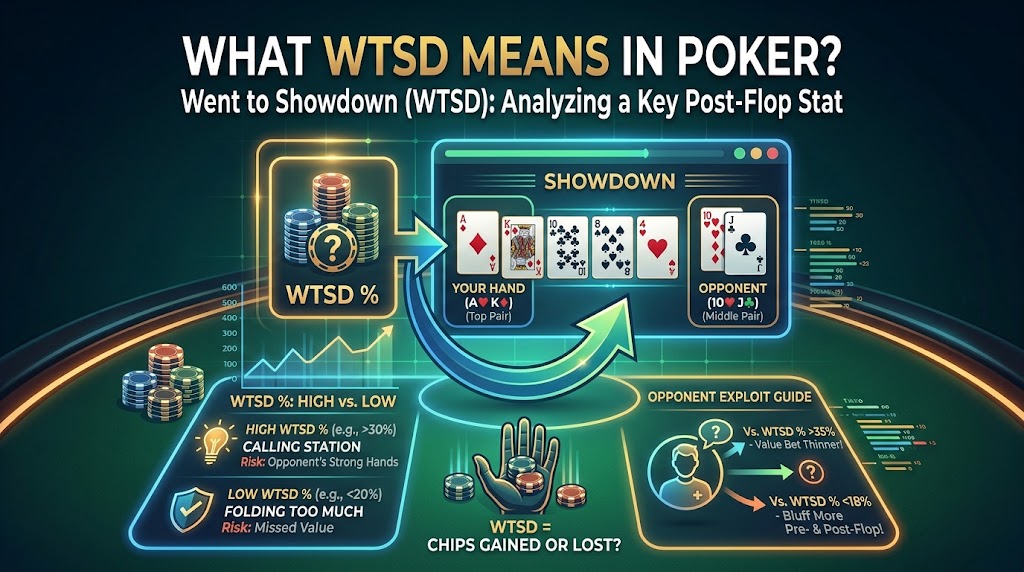
WTSD stands for Went to Showdown. It’s a HUD stat that measures what percentage of hands a player takes to showdown after seeing the flop. A WTSD around 25-30% is typical for solid regulars. High WTSD (33%+) signals a calling station – value bet relentlessly, don’t bluff. Low WTSD (under 22%) signals an over-folder – bluff more, don’t value-bet thin. Always read WTSD alongside W$SD and WWSF for the full picture.
WTSD stands for Went to Showdown. It’s a poker tracking statistic that measures how often a player reaches showdown after seeing the flop. Showdown is when at least two players remain in the hand after the final betting round (the river) and must flip their cards to determine the winner.
The stat appears in HUD software like PokerTracker 4 and Hold’em Manager, displayed as a percentage next to a player’s seat. It tells you, in one number, how willing that player is to stay in pots until the end rather than folding on the turn or river.
WTSD is one of the most informative post-flop stats available because it directly captures a player’s calling tendencies. A player who folds when they should call, or calls when they should fold, will show it clearly in their WTSD number over a large enough sample.
How WTSD Is Calculated
WTSD uses post-flop hands as its denominator, not all hands dealt. The formula is:
WTSD = (Hands reaching showdown) ÷ (Hands where player saw the flop) × 100If a player sees the flop 100 times and goes to showdown on 28 of those occasions, their WTSD is 28%.
What doesn’t count toward WTSD:
- Hands folded pre-flop
- Hands that end on the flop (opponent folds to a c-bet, for example)
- Hands that end on the turn
Only hands where the player saw the flop and then reached a showdown are counted. This makes WTSD a cleaner read on post-flop calling behavior than a stat like VPIP, which includes all streets.
What Is a Good WTSD Number
The generally accepted range for a solid, balanced player is 25-30% in 6-max cash games, with some sources suggesting 27% as a reasonable target. Full ring games run slightly lower due to tighter hand selection and more multi-way pots.
| WTSD range | Player type | Implication |
|---|---|---|
| Under 22% | Over-folder / nit | Folds too often on turn and river; bluff frequently |
| 22-25% | Tight regular | Goes to showdown with strong hands only; thin bluffs can work |
| 25-30% | Balanced regular | Solid range; no obvious exploit |
| 30-35% | Loose regular / fish | Calls too wide; value bet more, bluff less |
| 35%+ | Calling station | Calls with almost anything; bet for value relentlessly, almost never bluff |
These ranges are guidelines, not rules. The numbers shift based on game format, table size, and stake level. Recreational players at lower stakes typically run 30% or higher – they tend to chase draws, call down with weak pairs, and rarely fold on the river. Winning regulars at higher stakes typically sit in the 25-28% range.
High vs Low WTSD: What Each Tells You
High WTSD (33%+): the calling station
A player going to showdown more than a third of the time after seeing the flop is calling too wide. They’re chasing draws too often, calling river bets with weak pairs, and not folding when they should. Against this player type:
- Value bet every street with strong hands. They will call down with second pair, weak draws that didn’t get there, and bottom pair.
- Thin value betting becomes profitable. Hands you might check back against balanced players are worth betting for value here.
- Bluffing is mostly wasted money. A player who calls 35% to showdown is not folding rivers to your bluffs. Save bluff frequency for better spots.
- Avoid bluff-catch situations. When a high-WTSD player bets aggressively, they usually have something real.
Low WTSD (under 22%): the over-folder
A player reaching showdown fewer than 22% of the time is giving up too often on the turn and river. Their showdowns will show strong hands, but they’re leaving money on the table by folding too much. Against this player type:
- Bluff more, especially on turn and river. They fold to pressure on later streets far more than balanced players.
- Multi-street barrels work well. A double or triple barrel has higher fold equity against low-WTSD opponents.
- Don’t thin value bet. When this player calls the river, they usually have a strong hand. Their showdown range is narrow and strong.
- Respect their river bets. Low WTSD combined with a river bet is a strong sign of a made hand.
WTSD vs W$SD: The Pair That Matters
WTSD tells you how often a player reaches showdown. W$SD (Won Money at Showdown) tells you how often they win when they get there. These two stats are inversely correlated: as WTSD goes up, W$SD typically goes down, because calling to showdown more often means arriving with weaker hands on average.
| WTSD | W$SD | Reading |
|---|---|---|
| High (33%+) | Low (under 50%) | Classic calling station – calls too wide, wins less than half their showdowns |
| High (33%+) | High (55%+) | Running well or hitting everything; unsustainable, likely to regress |
| Low (under 25%) | High (60%+) | Tight, passive player – only goes to showdown with strong hands; bluff freely |
| Balanced (27-30%) | Balanced (50-55%) | Solid regular; no clear WTSD-based exploit available |
The target W$SD for a winning player is typically 50-55%. Below 50% means losing more showdowns than winning – a sign of calling too wide. Above 55% with a low WTSD suggests tight, value-heavy play with strong hands at showdown.
A common warning sign: high WTSD with low W$SD over a large sample means the player is consistently calling with losing hands. That’s the leak most calling stations share.
Reading WTSD with WWSF and VPIP
WWSF (Won When Saw Flop) measures how often a player wins the pot after seeing the flop – whether at showdown or not. An optimal WWSF is around 48%. Higher means aggressive post-flop (winning pots without showdown through betting and raising); lower means passive (checking and calling, letting opponents take pots).
The relationship between WTSD and WWSF is important:
- High WTSD usually pairs with low WWSF – calling stations reach showdown often but don’t win pots before getting there.
- Low WTSD usually pairs with high WWSF – aggressive players win pots through pressure without needing to reach showdown.
VPIP (Voluntarily Put Money In Pot) tells you how wide a player is opening pre-flop. A high VPIP combined with high WTSD confirms a loose passive player – entering many pots and calling down too often. A high VPIP with low WTSD is more unusual and might indicate a loose-aggressive player who semi-bluffs frequently but gives up on rivers.
Player Type Combinations
Reading WTSD alongside other stats identifies player types more accurately than any single number:
WTSD 25 / WWSF 42 / W$SD 55: Passive, straightforward player. Rarely bluffs, doesn’t take down pots without a hand, but goes to showdown selectively with strong holdings. Don’t bluff-catch against this player – when they bet the river, they have it.
WTSD 33 / WWSF 44 / W$SD 48: Classic fish or calling station. Calls too wide on every street, wins less than half their showdowns. Value bet everything; don’t run elaborate bluffs.
WTSD 28 / WWSF 49 / W$SD 48: Aggressive regular who bluffs enough to lower W$SD below 50% at showdown. Against this player, bluff-catching becomes viable on the right boards. They also take down pots without showdowns through aggression.
WTSD 20 / WWSF 52 / W$SD 62: Tight aggressive (TAG) player who wins pots through pressure without reaching showdown often. When they do reach showdown, they win 62% of the time. Bluff them on turns and rivers; don’t hero-call their river bets.
Sample Size Requirements
WTSD needs a large sample before you can trust it. The stat uses post-flop hands as its universe – and since most hands end pre-flop, post-flop samples accumulate slowly compared to pre-flop stats like VPIP.
A common guideline: treat WTSD as directional information below 500 hands, and reasonably reliable above 1,000-2,000 post-flop hands. Upswing Poker suggests needing around 8,000 total hands on a player before making significant strategy adjustments based on WTSD alone.
In practice, this means:
- An extreme number (WTSD of 40% or 18%) after 200 hands is meaningful enough to influence one decision, but shouldn’t define your whole approach.
- A moderate number (WTSD of 29%) after 200 hands tells you almost nothing – it could be running that way by variance.
- After 1,000+ hands, WTSD starts stabilizing and is worth weighting heavily in your decisions.
Tournaments vs Cash Games
WTSD is inherently higher in tournaments than in cash games. As stacks get shorter relative to blinds, players are forced into all-in situations more frequently, which produce showdowns regardless of hand strength. A tournament player with 20 big blinds going all-in pre-flop or on the flop will hit showdown at a much higher rate than a 100bb cash game player who can fold turns and rivers without risking their stack.
Typical tournament WTSD ranges run 5-10 percentage points higher than cash game equivalents. Benchmarking a tournament player’s WTSD against cash game norms will misread them. For tournament analysis, compare against tournament-specific baselines rather than the 25-30% cash game standard.
Analyzing Your Own WTSD
Your personal WTSD tells you something about your own leaks:
If your WTSD is above 32%: You’re probably calling too often on turns and rivers. Look at hands where you called a river bet and lost – were there clear fold signals you ignored? High WTSD is the statistical fingerprint of a player who pays off too many river bets.
If your WTSD is below 24%: You’re likely folding too often post-flop. Are you giving up flush draws and open-ended straight draws before seeing the turn? Folding too much on the turn when you have equity is a leak that WTSD exposes.
If your WTSD is in range but your W$SD is below 50%: You’re calling with hands that lose at showdown. This suggests calling too wide – chasing weak draws, calling down with bottom pair, or making hero calls that don’t hold up.
These flags don’t tell you exactly what to fix, but they point where to look in your hand histories.
FAQ
What does WTSD mean in poker?
WTSD stands for Went to Showdown. It’s a HUD statistic that measures the percentage of hands a player reaches showdown after seeing the flop. It’s displayed in poker tracking software like PokerTracker and Hold’em Manager as a percentage next to a player’s seat.
What is a good WTSD in poker?
A good WTSD for a balanced player in 6-max cash games is around 25-30%, with 27-28% being a commonly cited target. Below 22% suggests over-folding; above 33% suggests calling too wide. Full ring games typically run 2-3% lower than 6-max equivalents.
What does high WTSD mean?
A high WTSD (33%+) means the player reaches showdown frequently after seeing the flop – a sign they call too often on turn and river streets. Against high-WTSD players, value bet heavily and avoid bluffing. They’re unlikely to fold marginal hands to pressure.
What does low WTSD mean?
A low WTSD (under 22%) means the player folds too often after the flop, rarely reaching showdown unless they have a strong hand. Against low-WTSD players, bluff freely on turns and rivers. When they do bet the river, give their hand significant respect.
What is the difference between WTSD and W$SD?
WTSD (Went to Showdown) measures how often a player reaches showdown. W$SD (Won Money at Showdown) measures how often they win when they get there. The two stats are inversely related: players who go to showdown more often tend to win less frequently when they arrive, because they’re calling with weaker hands.
What is WWSF in poker?
WWSF stands for Won When Saw Flop. It measures how often a player wins the pot after seeing the flop, whether at showdown or not. A balanced WWSF is around 48%. Higher values indicate aggressive post-flop play; lower values suggest a passive, calling-heavy approach. Reading WWSF alongside WTSD gives a clearer picture of a player’s post-flop style.
How many hands do you need for WTSD to be reliable?
WTSD requires a significant sample. Most experienced players treat it as directional below 500 hands and reasonably reliable above 1,000-2,000 post-flop hands. Some sources recommend 8,000 total hands before making major strategic adjustments based on WTSD alone.
Is WTSD useful in live poker?
WTSD is a HUD stat designed for online poker where software tracks every hand automatically. In live poker, you don’t have access to running percentages, but the underlying concept applies: observing how often an opponent calls to showdown versus folds on later streets gives you the same read, just built from table observation rather than software.
Sources
- What is a HUD and What Stats Should You Include – Upswing Poker
- What is a Good WTSD in Poker – BlackRain79
- WTSD Went to Showdown Definition – PokerStrategy
- Essential Postflop Stats – Hand2Note
About the author
Marcus Reed
47 articlesTrending
Best Mathematical Craps Strategy: What the Numbers Actually Say

Multiplier Symbols: Boosting Your Winnings in Online Slots

What Is Autoplay in Online Casino Games? Pros and Cons
Lucky Ducky slot Review
![Flat Bet Definition and Meaning [CASINO] [GUIDE]](https://wolfbet.com/blog/wp-content/uploads/2025/02/casino-pic-768x512.jpg)

![Doggy Riches Megaways Review [Red Tiger]](https://wolfbet.com/blog/wp-content/uploads/2025/02/doggy-riches-megaways-slot-review-casino-game-768x421.jpg)