Best Mathematical Craps Strategy: What the Numbers Actually Say
Craps attracts more strategy systems than almost any other casino game. The 3-Point Molly, the Iron Cross, the Martingale, the Press and Regress, the Place and Chase – the list is long and the claims are often confident. Most of them are built on a real mathematical foundation. Almost none of them do what their proponents claim.
The math of craps is fixed and fully knowable. Two dice, 36 possible combinations, probabilities that do not change between sessions. What separates a decent approach from a bad one is not finding some trick the house missed – it is structuring your bets so the house earns as little as possible from your action.
This guide covers what the numbers actually support, two strategies worth knowing, and why every system that promises to “beat” the house edge is working from a false premise.
The Foundation: Craps Probability Is Fixed
Before any strategy makes sense, you need the raw numbers. Two standard six-sided dice produce 36 possible combinations. The distribution is not flat.
| Sum | Combinations that produce it | Probability |
|---|---|---|
| 2 | 1 (1+1) | 2.78% |
| 3 | 2 (1+2, 2+1) | 5.56% |
| 4 | 3 | 8.33% |
| 5 | 4 | 11.11% |
| 6 | 5 | 13.89% |
| 7 | 6 (1+6, 2+5, 3+4, 4+3, 5+2, 6+1) | 16.67% |
| 8 | 5 | 13.89% |
| 9 | 4 | 11.11% |
| 10 | 3 | 8.33% |
| 11 | 2 | 5.56% |
| 12 | 1 (6+6) | 2.78% |
Seven appears on 6 of 36 combinations – more than any other sum. This is not a casino trick. It is geometry. Two six-sided dice produce more paths to 7 than to any other number, and that fact is built into every craps bet on the table.
Once you understand this table, craps strategy becomes a question of which bets are priced fairly against these probabilities and which are not. The pass line and odds bet are. Most of the centre of the table is not.
For the full breakdown of which bets to place and which to skip, see our Best Bets in Craps guide.
What “Best Mathematical” Actually Means
No craps strategy produces a positive expected value against a licensed RNG casino. The house edge is built into the payout structure, not into any manipulation – the dice (or the RNG) produce fair outcomes, and the casino earns its margin from payouts that are slightly below true odds on most bets.
What a mathematical strategy can do:
- Minimize the effective house edge on your total money at risk
- Control how quickly variance affects your bankroll
- Maximize the number of rounds you get from a given session budget
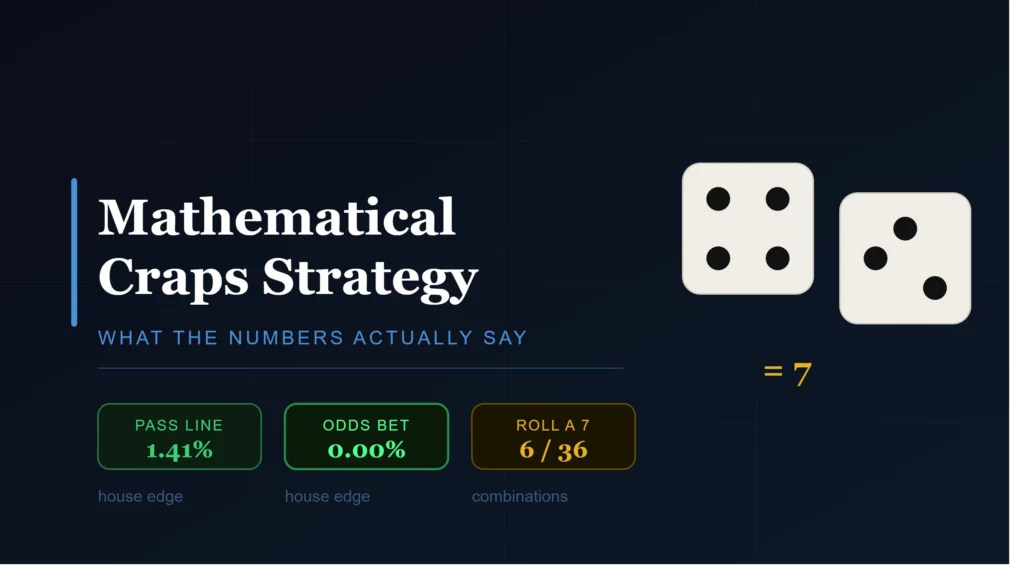
The best mathematical craps strategy is the one that keeps the most money working at the lowest possible edge. That leads to the pass line plus maximum odds bet as the foundation – 1.41% on the pass line, 0% on the odds bet behind it. Our Best Craps strategy guide covers this in full.
Beyond that foundation, two structured approaches are worth understanding: the 3-Point Molly and the Iron Cross.
The 3-Point Molly
The 3-Point Molly is the most widely recommended mathematical craps strategy for players who want multiple numbers active while keeping edge exposure low.
How it works:
Start with a pass line bet before the come-out roll. Once a point is established, add maximum odds behind the pass line. Then place a come bet. When that come bet establishes its own point, back it with maximum odds. Place a second come bet. When that establishes a point and you have backed it with odds, stop placing new bets.
You end up with three bets active simultaneously – the pass line and two come bets, each backed by maximum odds. Three numbers working, all at the lowest house edge available.
The math:
If you are playing pass line plus 5x odds and two come bets also at 5x odds, your combined effective house edge on the total money at risk is roughly 0.33-0.50%, depending on the specific points established. That is competitive with basic strategy blackjack.
The real cost: the 7-out.
When a 7 rolls during the point phase, all three active bets lose simultaneously. That is the downside nobody mentions as often as the upside. You can build up three numbers over several rolls and lose all of them in a single roll. The 3-Point Molly concentrates risk in an interesting way – it gives you more winning rolls than losing rolls (since many numbers resolve before a 7), but the losing rolls are expensive.
Bankroll requirement:
At $5 pass line with 5x odds ($25 odds) and two $5 come bets with $25 odds each, you are covering $90 per fully loaded position. Bring at least $300-$400 to a session using this structure, or scale down proportionally. On Playtech Craps at Wolfbet, the minimum bet is $0.01 – you can run the same structure for fractions of that.
The Iron Cross
The Iron Cross is the other major structured approach. It covers every outcome except 7.
Setup: Place the 5, 6, and 8, then add a field bet. Every roll that is not a 7 pays something – the field covers 2, 3, 4, 9, 10, 11, and 12, while the place bets cover 5, 6, and 8. Together, that is every possible outcome except 7.
Why people like it: You win on almost every roll. In a session where few 7s appear during the point phase, it generates a steady stream of small wins that feels satisfying.
What the math says:
The field bet carries a house edge of 5.56% on a standard table. The place 5 carries 4.0%. Place 6 and 8 sit at 1.52% each. Combined across a typical Iron Cross setup, the effective total edge on your money is roughly 2.5-3.5%, depending on how you weight the bets.
That is two to seven times worse than the 3-Point Molly.
| Strategy | Bets active | Effective total edge | Wins on most rolls? |
|---|---|---|---|
| Pass line + 5x odds | 1-2 | ~0.33-0.50% | No – only when point hits |
| 3-Point Molly | 3 | ~0.33-0.80% | No – only when a number hits |
| Iron Cross | 4 | ~2.5-3.5% | Yes – on every non-7 roll |
| Iron Cross vs 3-Point Molly cost difference | – | ~2-3% more per dollar at risk | – |
The Iron Cross is a psychological strategy dressed as a mathematical one. It trades a lower edge for the feeling of winning constantly. Over enough rounds, the higher edge grinds harder than the 3-Point Molly, even though individual sessions can look different.
I am not saying never use it. Some players like the feel of collecting on nearly every roll, and if that keeps them at the table longer without frustration, there is a case for it. Just be clear that you are paying for the experience, not improving your expected return.
Why Martingale Fails at Craps
The Martingale – doubling your bet after every loss until you win – comes up in craps discussions regularly. The logic sounds watertight: eventually you win, and when you do, you recover all previous losses plus one unit of profit.
The problem is not the logic. It is the scale.
Pass line losing streaks of 7-10 in a row are unlikely on any given session but not rare across thousands of rounds. Starting at $5:
| Losing streak | Required next bet | Total at risk |
|---|---|---|
| 1 loss | $10 | $15 |
| 3 losses | $40 | $75 |
| 5 losses | $160 | $315 |
| 7 losses | $640 | $1,275 |
| 9 losses | $2,560 | $5,115 |
| 10 losses | $5,120 | $10,235 |
Most online craps tables cap bets at $500-$1,000. After 7-8 losses, Martingale hits the table maximum and the recovery becomes impossible. You are left with thousands of dollars lost and no path back.
More fundamentally: Martingale does not reduce the house edge. Each individual pass line bet still carries 1.41% regardless of what preceded it. You are not changing your odds – you are changing how much you lose when a bad streak arrives. That is the opposite of a mathematical improvement.
The One Thing That Actually Works Mathematically
The odds bet. It is the only bet in any standard casino game with a 0% house edge. It pays true odds – exactly what the probability of each outcome warrants, with no casino margin.
After a point is established, you can place the odds bet directly behind your pass line or don’t pass. The amount is limited by the table’s odds multiplier – 3x, 5x, or 10x are common at online tables.
The higher the multiplier, the more money you can shift from the 1.41% edge pass line to the 0% edge odds bet, and the lower your effective combined edge becomes.
| Odds multiplier | Effective combined house edge |
|---|---|
| 0x (pass line only) | 1.41% |
| 1x | 0.85% |
| 3x | 0.47% |
| 5x | 0.33% |
| 10x | 0.18% |
No system, strategy, or betting progression gets your edge lower than maximum odds on pass line and don’t pass. Everything else is structure around that core bet.
Applying This to Online Craps at Wolfbet
The mathematics above applies identically whether you are at a physical table or playing online. The dice combinations are the same. The house edge per bet is the same.
At Wolfbet’s dice category, four games cover different formats:
Mega Sic Bac (Pragmatic Play Live, 98.26% RTP) uses two dice with random multipliers – different mechanic from pass line craps, but the highest RTP in the category. Sic Bo by Beter Live (97.22% RTP) offers standard three-dice live play up to $100 per round. MONOPOLY Roll ’em (Evolution Gaming, 96.97% RTP) is Evolution’s live dice hybrid at max $1.50 per round. Sic Bo Dragons (Volt Entertainment, 96.19% RTP) is the RNG option with demo mode and four dice.
For the classical pass line and odds bet experience with the math described in this article, Playtech Craps is the table to use. Demo mode is available – you can run 3-Point Molly sessions in free play before staking anything.
Frequently Asked Questions
Is there a mathematical system to beat craps? No. The house edge is built into the payout structure and applies to every bet regardless of what preceded it. What mathematical strategies do is minimize the edge on your total action – they do not eliminate it.
What is the best mathematical craps strategy? Pass line with maximum odds is the baseline. For players who want multiple numbers active, the 3-Point Molly (pass line plus two come bets, all backed by maximum odds) is the best structured approach at roughly 0.33-0.80% combined effective edge.
Is the Iron Cross a good strategy? It produces wins on almost every non-7 roll, which feels satisfying. The combined house edge is roughly 2.5-3.5% – significantly worse than the 3-Point Molly. It works as an entertainment choice if the constant action appeals to you, but it costs more per session than approaches built on pass line and odds.
Does Martingale work in craps? No. It does not change the house edge on any individual bet. Long losing streaks hit table maximums before recovery is possible, and the cumulative losses during a streak can be severe.
What is the probability of rolling a 7 in craps? Six of 36 possible dice combinations produce a 7 – a probability of 16.67%, higher than any other single sum. This is why the pass line loses during the point phase when a 7 rolls before the established point.
Play craps at Wolfbet. Test the 3-Point Molly in demo mode with Playtech Craps, or try the live experience with Mega Sic Bac (98.26% RTP) and Sic Bo by Beter Live. Deposit with Bitcoin, Ethereum, USDT, Monero, Zcash, Dogecoin, Visa or Apple Pay.
WOLFBET is owned and operated by Cipher Games Ltd, registration number: 125414, Marshall Islands. Licensed by the Government of Anjouan, Union of Comoros under License No. ALSI-132405048-FI3. 18+ only. Play responsibly.
About the author
Marcus Reed
81 articlesTrending

What Does Fold Mean in Poker?

This Casino Game Is Older Than Every Currency You’ve Ever Used
![Book of Tut Megaways Review [Pragmatic Play]](https://wolfbet.com/blog/wp-content/uploads/2025/02/book-of-tut-megaways-casino-game-wolfbet-768x385.jpg)
Book of Tut Megaways Review [Pragmatic Play]

3 Egypt Chests Slot Review: Uncover 5,000x Jackpots with Hold and Win Respins
![How To Play (And Win) at High Low Card Game [Strategy]](https://wolfbet.com/blog/wp-content/uploads/2025/01/hi-lo-game-768x400.jpg)
![Sumo Supreme Megaways Review [Pragmatic Play]](https://wolfbet.com/blog/wp-content/uploads/2025/02/sumo-supreme-megaways-slot-review-demo-768x432.jpg)