Why Is Crypto Down? Midterms, the Fed & What’s Next
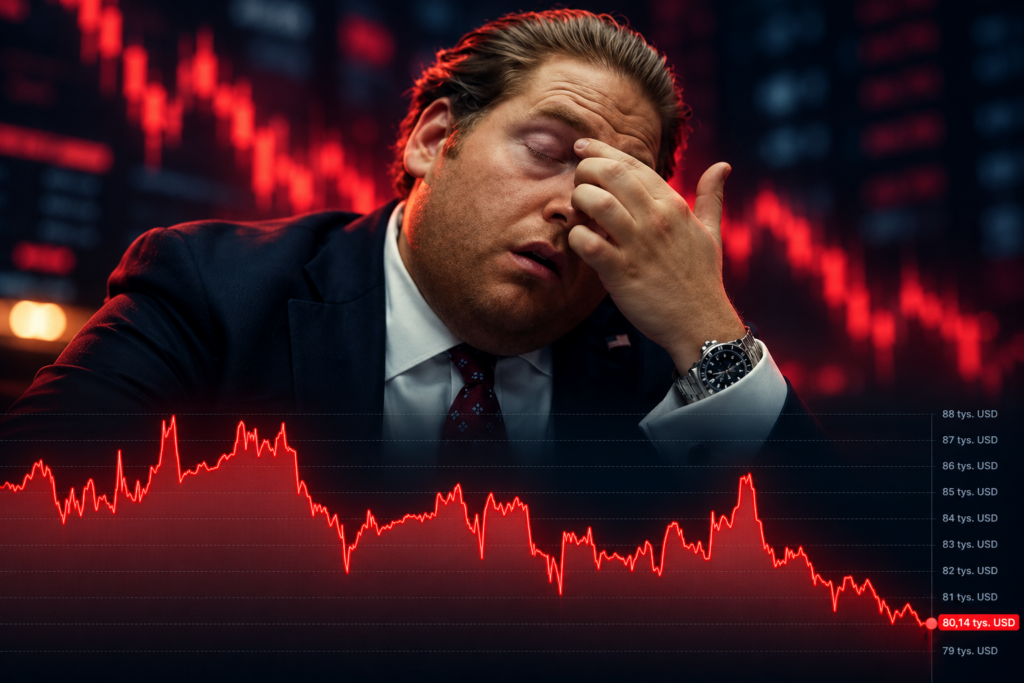
If you’ve been searching “why is crypto down today”, you’re not alone. Bitcoin slipped below $80,000 overnight into Monday, its lowest level since September 18 (CryptoTicker), and most altcoins fell with it. With the US midterm elections a week away, the next question is obvious: do elections actually move crypto prices?
The short answer is yes, but mostly indirectly. Elections don’t change how Bitcoin works. What they can change is the pace of crypto regulation, the direction of the dollar and the mood of the wider market, and all three matter for price.
Here’s what history shows, what the markets already expect, and why this week’s Fed decision probably matters more than the vote itself.
Slots to try on Wolfbet Casino


US midterms 2026: what’s on the ballot on November 3
The midterms happen halfway through a president’s four-year term. The presidency itself isn’t on the ballot: voters choose the entire House of Representatives and about a third of the Senate. The outcome decides which party controls Congress for the next two years, and with it, how easily new laws can pass.
For crypto, that matters because Congress has been stuck on market-structure legislation. The CLARITY Act failed a key Senate vote in September, so the next Congress will shape what happens to it.
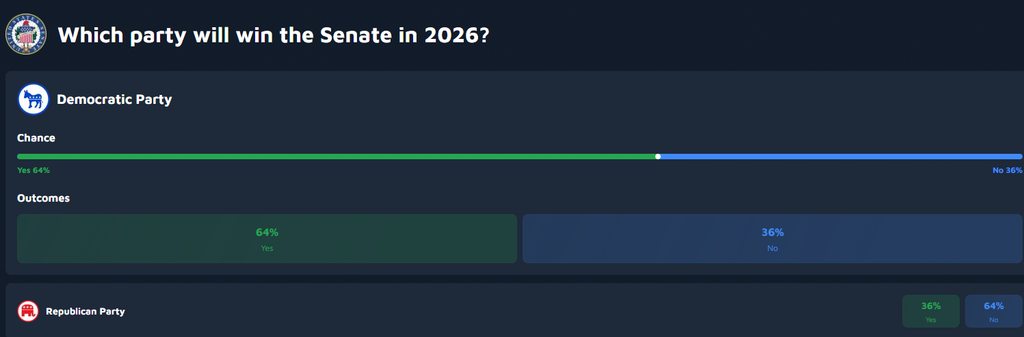
Prediction markets have a clear expectation. As of October 8, Kalshi and Polymarket gave Democrats about a 90% chance of winning the House and about 63% for the Senate. The chance that Republicans keep both chambers was around 9% (DeFi Rate).
That point matters for traders. When an outcome is this widely expected, much of it may already be priced in. A surprise result would likely move the market more than the expected one.
Does Bitcoin crash after midterm elections? What history says
The statistic going around crypto Twitter this month comes from analyst Ali Martinez. After each of the last four midterms, Bitcoin fell sharply (cryptonews.net):
| Midterm year | President mid-term | BTC decline after the election |
|---|---|---|
| 2010 | Obama (1st term) | 72% |
| 2014 | Obama (2nd term) | 65% |
| 2018 | Trump (1st term) | 52% |
| 2022 | Biden | 27% |
First, correlation isn’t causation. Martinez himself notes the pattern doesn’t prove the elections caused the declines. Those midterm years happened to line up with Bitcoin’s four-year market cycle, which tends to bring a bear phase around that time regardless of politics.
Second, 2010 barely counts. Bitcoin was a tiny, illiquid market back then. Most analysts only treat 2014, 2018 and 2022 as midterms where Bitcoin had real liquidity (TradingKey).
Third, the same history has a flip side. In the last three cycles, Bitcoin found its bottom 13 to 71 days after the midterms and then recovered. This year may not follow the script at all: Bitcoin’s 2026 low came on July 1, well before the vote (24/7 Wall St.).
How do US elections affect crypto prices?
If history is a weak guide, the better question is: through which channels can the result reach the price? There are three main ones.
Regulation. A change in control of Congress could make crypto-friendly legislation harder to pass (CryptoPotato). But much of the momentum on crypto rules now comes from the SEC and CFTC rather than Congress, which softens the impact (Pepperstone).
The dollar. Glassnode says Bitcoin’s inverse correlation with the dollar recently hit its strongest level on record. If a new Congress reins in spending and eases deficit worries, the dollar could strengthen, which has tended to weigh on Bitcoin (Bloomingbit).
Geopolitics and oil. The same report notes a possible offsetting effect. If political change helped ease Middle East tensions, lower oil prices could cool inflation, reduce pressure for rate hikes and support Bitcoin.
These channels don’t hit every asset equally. Bitcoin increasingly trades like a macro asset, while altcoins, DeFi tokens and crypto stocks are more sensitive to regulation. Pepperstone’s scenarios reflect that:
| Outcome | Likely effect |
|---|---|
| Democrats win both chambers | More uncertainty for market-structure rules; hits altcoins, DeFi and crypto stocks harder than BTC |
| Split Congress | Oversight without major new laws; status quo for crypto rules |
| Republicans keep both chambers | Renewed hopes for legislation; could support ETH, SOL, DeFi and crypto stocks |
The split-Congress row reflects the general view that divided government tends to deliver oversight rather than big legislation (Bitbase).
Why is Bitcoin down today? The Fed matters more this week
If you’re watching Bitcoin right now, the election is only part of the picture. The weekend drop below $80,000 came from three forces hitting at once (CryptoTicker):
- Oil: reports of possible new strikes on Iran pushed Brent crude up more than 6% to about $117 a barrel.
- ETF outflows: spot Bitcoin ETFs lost about $773 million over October 22–23, alongside a sell-off in AI stocks.
- Liquidations: around $670 million in positions were wiped out as BTC broke $80,000, mostly leveraged longs.
The next big tests come before the vote. The Fed announces its rate decision on October 28, and a large options expiry follows on October 30. With September inflation coming in at 3.7% (The Crypto Times), the market is still pricing a chance of another rate hike.
The levels traders are watching: holding $79,600–$80,000 and reclaiming $81,000 would open a path back toward $84,000. A daily close below $79,200 would bring $76,000 into view.
The long-term view: what if Bitcoin returns to its all-time high?
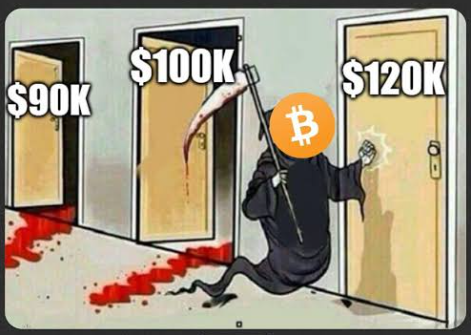
Most of this article is about the next few weeks. Long-term holders tend to look at it differently: if you believe Bitcoin will eventually return to its previous record, or break it, a dip below $80,000 looks less like a crash and more like a gap to that level.
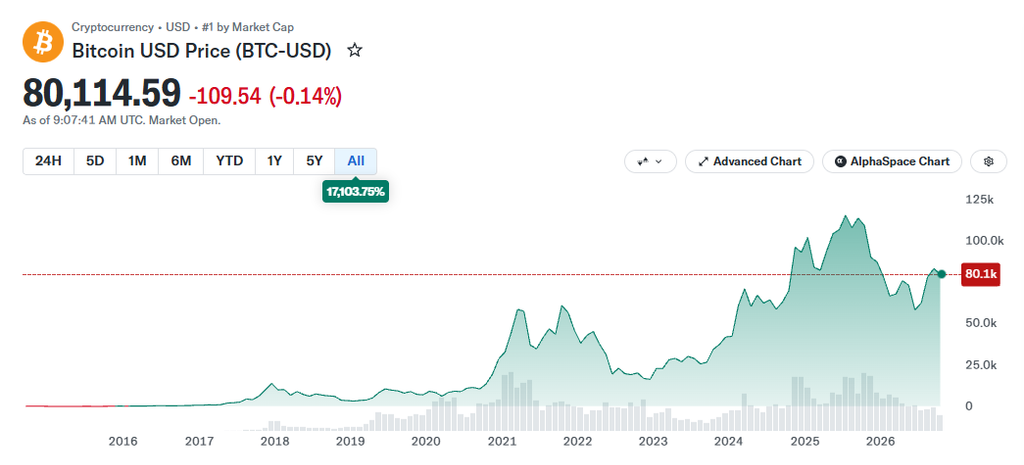
Bitcoin’s all-time high came in October 2025, when it passed $125,000 for the first time and peaked around $126,000 (The Daily Star). Here’s what different targets would mean from today’s price of about $80,000:
| Scenario | Price | Move from $80,000 |
|---|---|---|
| Back to the previous all-time high | ~$126,000 | +57.5% |
| New record | $150,000 | +87.5% |
| New record | $200,000 | +150% |
These are scenarios, not forecasts. Nobody knows if or when Bitcoin gets there, and the long-term approach only works if you can sit through the drops along the way. Bitcoin already fell roughly 50% from its record to near $63,000 earlier this year (CryptoTicker).
The downside math from $80,000 matters just as much:
| Scenario | Price | Move from $80,000 |
|---|---|---|
| Bearish level traders are watching | $76,000 | -5% |
| Short-term holder cost basis | ~$73,000 | -8.75% |
| A 2022-style post-midterm decline (-27%) | ~$58,400 | -27% |
This is why many long-term investors spread purchases over time (often called dollar-cost averaging) instead of trying to time the bottom, and avoid leverage, which can wipe out a position before any long-term thesis has a chance to play out.
Crypto FAQ: buy, sell or wait before the midterms?
Is it a good time to buy crypto before the midterms? Nobody can time that reliably. Historically, Bitcoin has been weak around midterm years and recovered in the months after, but those moves lined up with its own market cycle rather than the vote. This year, the 2026 low came on July 1, so the pattern may not repeat. Expect higher volatility around both the Fed decision and election night.
Should I sell my crypto before the election? That depends on your time horizon and how much volatility you can handle. The result is already widely expected by prediction markets, so a surprise outcome is more likely to move prices than the expected one. Leveraged positions carry the most risk in weeks like this: around $670 million in positions were liquidated in the latest drop below $80,000.
Will Bitcoin go back up after the midterms? In the last three cycles, Bitcoin bottomed 13 to 71 days after the midterms and then recovered. That’s a historical pattern, not a guarantee, and the Fed, oil prices and the dollar are currently bigger drivers than the vote.
Will crypto crash after the election? Past post-midterm declines ranged from 27% to 72%, but they happened during Bitcoin bear cycles. A smaller market back then, plus today’s spot ETFs and institutional demand, make a direct comparison difficult.
Which cryptocurrencies could be most affected by the midterms? Altcoins, DeFi tokens and crypto stocks are more sensitive to regulation than Bitcoin, so they’re likely to react more to a change in control of Congress.
Bottom line
The midterms can move Bitcoin, but probably not in the dramatic way the historical chart suggests. Past post-election crashes lined up with Bitcoin’s own market cycle, and this year’s low may already be behind it.
The result is more likely to show up in volatility and in regulation-sensitive assets like altcoins and crypto stocks than in Bitcoin itself. For BTC, the Fed, oil and the dollar remain the bigger drivers, and the first of those arrives on Wednesday.
This article is for informational purposes only and is not financial advice. Crypto assets are volatile; always do your own research.
About the author
Marcus Reed
84 articlesTrending

Bitcoin Faucets: Are They Legit & Worth Your Time? [2020]

5 No Deposit (Free) Crypto Casino Bitcoin Bonuses for 2021

Muertos Multiplier Megaways Review

Piggy Riches Megaways Slot Review [Red Tiger]