Best Keno Numbers Combinations: Odds, Probability Tables and Payouts
Updated: 23 November 2026
Many players search for the best Keno numbers combinations, hoping that a certain set of numbers will win more often. The honest answer is that no combination is better than another with the same number of spots. Each draw is generated by a random number generator (RNG), so every ticket has the same chance as any other ticket with the same spot count. This guide shows the exact probabilities behind a Keno ticket, explains why popular number systems do not change them, and covers the practical points that matter before you play.
How a Keno Round Works
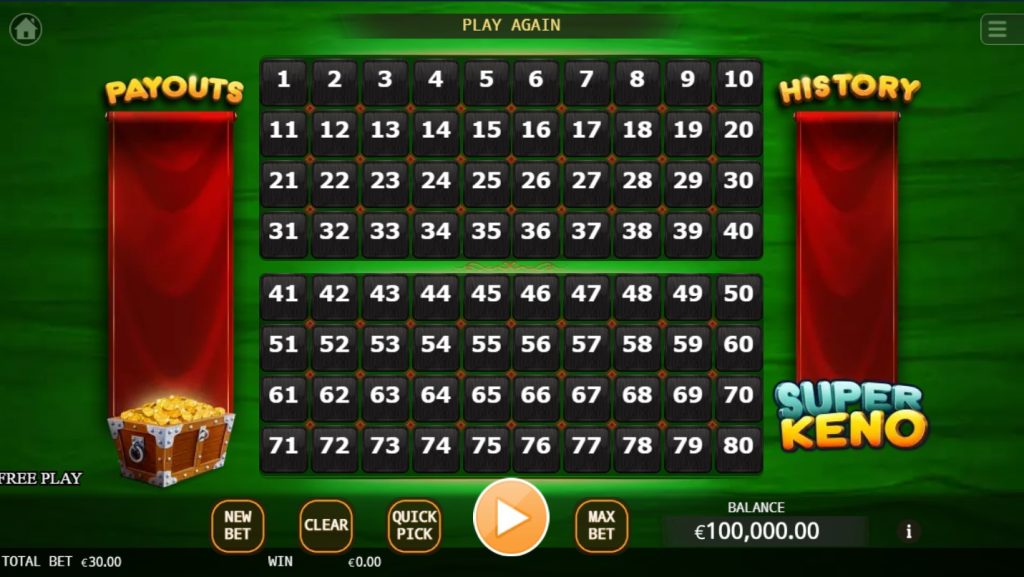
A Keno round draws a set of winning numbers from a fixed pool. The pool size and the number of drawn numbers depend on the game. The classic version uses 80 numbers, of which 20 are drawn. Many online variants use a different board, so always check the rules of the specific game.
You choose your numbers, called spots. You win if enough of them are among the drawn numbers. The payout depends on how many spots you chose and how many you hit, according to the paytable of that game.
Each draw is independent. The result of the previous round does not change the chance of any number in the next one.
The Exact Probabilities
On a standard 80-number board with 20 numbers drawn, the chance that one specific number is drawn is 20/80 = 25%. The table below gives the chance of different outcomes for tickets with 1, 2 and 4 spots. These are hypergeometric probabilities, and they depend only on the number of spots you choose.
| Your spots | Exactly 1 hit | At least 1 hit | All spots hit |
|---|---|---|---|
| 1 spot | 25.00% | 25.00% | 25.00% |
| 2 spots | 37.97% | 43.99% | 6.01% |
| 4 spots | 43.27% | 69.17% | about 0.2% (about 1 in 500) |
On 2 spots, the chance of both numbers being drawn is 20/80 × 19/79 = 19/316, which is about 6.01%. On 4 spots, the chance of all four being drawn is about 1 in 500. Note that 19/79 is a conditional probability (the chance of the second number after the first was drawn), not odds.
The Full Board
The number of possible 20-number draws from 80 is C(80,20) = 3,535,316,142,212,174,320. That is the size of the draw space, not the chance of a typical ticket. A player who picks 10 spots and needs all 10 to be drawn has the following chance: C(20,10) / C(80,10) = 184,756 / 1,646,492,110,120, which is about 1 in 8.91 million.
Do Popular Numbers Change the Odds?
Many articles publish lists of “hot” numbers, and players often choose them. Two questions need to be kept apart:
- Which numbers do players pick? Some numbers are chosen more often because of birthdays, anniversaries or habit. This is a fact about player behaviour.
- Which numbers does the RNG draw? In a fair game, every number has the same chance of being drawn in each round. Past results do not change this.
Over a finite sample, the count for each number fluctuates around its expected value. Some numbers look “hot” for a while, but this is normal variance. It does not predict future draws, and a number drawn often in the past has exactly the same chance next time.
Common Player Picks
- Birthdays, anniversaries or a house number. The draw does not know these dates, so the chance is the same as for any other set.
- Doubles such as 11, 22 and 33, a straight run such as 1 to 10, or multiples of 5. Each set has the same chance as any other set with the same number of spots.
- Shapes on the board: rows, columns, diagonals, corners or edges. The shape does not change the payout. It can make a ticket easier to read.
- Quick Pick and copying the last draw. Both give the same chance as a hand-picked ticket.
Mixing odd and even numbers or high and low numbers changes the look of a ticket, not its odds. Treat it as a matter of taste.
Verifying a Draw with Provably Fair
Some Keno games use a provably fair system, which lets you check a result yourself. The outcome is built from three values:
- Server seed: a secret value generated by the operator. Before you play, the game usually shows only its hash, a fingerprint that cannot be turned back into the seed.
- Client seed: a value you can set or confirm. Because you supply part of the input, the operator cannot determine the result alone.
- Nonce: a counter that increases with each bet, so the same pair of seeds gives a different draw in every round.
The values are combined by a published algorithm. The exact procedure differs between games, so read the fairness page of the specific game.
Step-by-Step Verification
- Before you bet, copy the hash of the server seed shown by the game and store it safely.
- Set or confirm your client seed, and note the nonce for the round.
- Play the round and record the numbers you received.
- To reveal the server seed, rotate your active seed pair in the fairness settings. This retires the current server seed and shows its plain-text value. The operator does not reveal the seed of an active pair, because players could then calculate the outcomes of upcoming nonces before placing bets.
- Hash the revealed server seed with the same method the game uses, and compare the result with the hash you saved in step 1. A match shows that the seed was fixed before you bet.
- Enter the server seed, client seed and nonce into the operator’s verification tool. The numbers it reproduces should match the ones you saw.
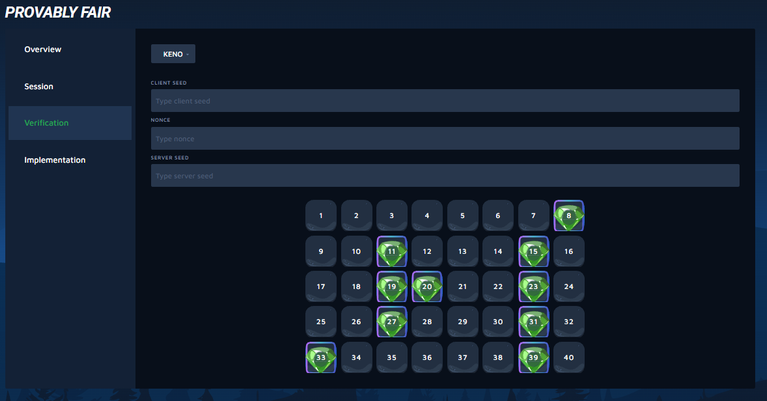
On Wolfbet’s provably fair page, the Verification tab asks for the client seed, the nonce and the server seed. Once you enter them, the tool marks the drawn numbers on a board of 40, so you can compare them with your round.
What a Successful Check Proves
A match shows that the outcome agrees with the seeds, the nonce and the published procedure, and that the server seed was committed before you bet. It does not prove that the rest of the operator’s software is fair, including payout code. Verifying the whole system requires an independent audit.
Paytables, Spots and Risk Settings
The number of spots you choose changes which outcomes are possible, and the paytable sets how much each outcome pays. Two terms are often confused:
- Volatility describes how wins are spread. A low-risk table pays smaller wins more often, while a high-risk table depends on rarer, larger wins.
- RTP (Return to Player) describes the long-run return across all outcomes.
Some games offer low and high risk settings, and each has its own RTP. Compare the paytable and RTP for each setting before you play. Changing the number of spots changes volatility and the paytable. It does not change the house edge.
Payouts and Spot Counts
Payouts depend on the spot count and the paytable together. The same number of hits can pay very differently on tickets with different spot counts. On a ticket with many spots, a small number of hits often pays nothing. Check the paytable for your exact spot count before you play, and do not assume a payout from a different ticket.
Some variants use other pool sizes. For example, a 70-number pool with 20 drawn gives each number a chance of 20/70, about 28.6%. The rules of the game determine the odds, so read them.
Bonuses and Wagering Requirements
Welcome bonuses can add to your bankroll, but they come with conditions. Before you claim a bonus, check:
- Wagering (playthrough) requirements: how many times you must bet the bonus amount before any winnings can be withdrawn.
- Game contribution: whether Keno counts toward the requirement, and at what percentage.
- Maximum bet and withdrawal limits while the bonus is active.
- Expiry dates for the bonus and its requirements.
A bonus does not change the odds of any Keno draw. It only changes the conditions under which you can withdraw money.
Autoplay and Bet Sizing
Autoplay and fast-pick make it easy to play many rounds in a short time. This speeds up the rate at which your bankroll decreases on average, because each round carries the house edge. Changing your bet size after wins or losses does not change the odds of the next draw. Set your bet size and round count before you start autoplay, and stick to them.
Bankroll Management and Betting Progressions
Before a session, decide how much you are willing to lose and treat that amount as your bankroll. Keep it separate from money needed for bills or savings. Set a time limit, for example 30 minutes, and when either limit is reached, end the session, even if you are ahead or behind.
Flat Betting
Flat betting means wagering the same amount on every draw. It keeps losses predictable, and with a loss limit and a time limit it sets a clear ceiling on what a session can cost. It does not make Keno profitable.
The Martingale System
Martingale doubles the stake after each loss, so one win is expected to recover all earlier losses plus a profit. In Keno this fails, because most winning tickets pay less than double the stake. Here is an illustrative example on a 10-spot paytable where matching 3 numbers pays 1.4 times the stake:
- You bet 1 unit and lose. Total staked: 1.
- You bet 2 units and lose. Total staked: 3.
- You bet 4 units and lose. Total staked: 7.
- You bet 8 units and match 3 numbers. The payout is 8 × 1.4 = 11.2 units. Total staked: 15. You are still 3.8 units down.
After 17 losses in a row, the next Martingale stake from 1 unit would be 2^17 = 131,072 units. Few bankrolls can follow that growth.
Myths About Predicting Keno Numbers
There is no reliable method to predict Keno numbers. These common beliefs do not hold:
- Patterns in past draws have no predictive power, because each draw is independent.
- “Hot” and “cold” numbers do not become more or less likely to be drawn in future rounds.
- Numerology, lucky numbers and superstitions do not change your odds.
- Systems that claim to guarantee wins are not supported by probability.
- Splitting a fixed budget into smaller bets extends your session and changes how it feels, but it does not change the chance of a hit on any single draw or the house edge.
Responsible Gambling
Keno is entertainment, not income. Use these rules before and during every session:
- Never chase losses. Adding money to win back losses raises the total at risk. Each draw’s odds stay the same.
- Always set limits. Decide on a budget and a time limit before you start, and stick to them.
- Take regular breaks. Step away at set intervals, and stop when the limit is reached.
If gambling stops being fun or starts to affect your finances, stop playing and seek support from a responsible gambling service in your country.
Frequently Asked Questions
What are the best Keno numbers combinations?
In terms of chance, no combination is better than another with the same number of spots. Every ticket has the same probability of hits as any other ticket with the same spot count. A combination can be your favourite, but it does not improve your odds.
Is there a winning strategy for Keno?
No strategy changes the odds of a draw. Bankroll limits help you control spending, and spot-size choices change volatility and the paytable, not the chance of a fair draw. Progressive systems such as Martingale also do not create profit.
Which Keno numbers hit the most?
Over any finite sample, some numbers are drawn more often than others by chance. These counts do not predict future draws, so choosing numbers from past frequency lists does not improve your odds.
Does picking sequential numbers work?
Sequential numbers have the same chance of being drawn as any other set with the same number of spots. Any win on a sequential ticket is a result of chance, the same as a win on any other ticket.
How many spots should I play?
There is no single best number of spots. More spots mean a higher chance of some hit, but the payouts for each hit are smaller and the paytable decides the balance. Compare the paytable and RTP for the spot count you want before you play.
Does a bonus improve my odds?
No. A bonus does not change the odds of any draw. It can change how much you can play, but it comes with wagering requirements that must be met before withdrawal.
Is a provably fair check enough to trust a game?
A single-round check confirms that a result matches the seeds and the published procedure. It does not verify the whole system, which requires an independent audit.
Conclusion
Keno outcomes are random. The best Keno numbers combinations, in terms of odds, are the same as all the others with the same spot count. Your choice of numbers changes how the ticket looks, not the chance of a hit. Before you play, check the paytable and RTP, read the bonus terms, verify a round if the game is provably fair, and set a budget and a time limit.
If you choose to play crypto Keno at Wolfbet, read the game rules and the fairness page first.
Gamble responsibly. Only bet what you can afford to lose.
About the author
Mark
106 articlesTrending
2 Wild 2 Die Slot Review: Hacksaw Gaming’s 15,000x Wild West Thriller
How Random Number Generators Actually Work in Online Slots

Crypto Casino Canada 2026: Legal Status, Tax Rules and How to Play

How to Play Ethereum Dice (and Keep the Gas Fee Out of Your Odds)