Craps for Complete Beginners: Table Layout and Basic Bets Explained
Updated: 27 October 2026
A craps table looks like a cockpit. Numbers everywhere, dealers calling out things in half-code, chips flying between hands you cannot quite follow. Most of that felt is decoration. Once you know what five or six sections actually mean, the rest of the table is just repetition.
This guide walks through the layout section by section, defines the bets you will actually use, and gives you the house edge for each one. The house edge tells you which bets are worth making and which ones exist to separate players from their money.
Slots to try on Wolfbet Casino
-
 Irish Coins
KA Gaming Slots
-
 Fat Panda
Pragmatic Play Games
-
 Fear The Dark
Hacksaw Slots
-
 Deal With Death
Hacksaw Gaming
-
 Great Book of Magic Deluxe
Voltent Slots
-
 Fruit Frenzy
Ea Gaming Slots
-
 Big Bass Football Bonanza
Pragmatic Play
-
 Big Bass Floats My Boat
Pragmatic Play
-
 Klowns
Hacksaw Gaming
-
 Blockchain Megaways
Booming Games Slots
Key takeaways
- A craps table has two mirrored betting areas, one on each side, plus a shared centre for proposition bets. You only need to understand one side.
- The pass line and don’t pass bar are the foundation of the game. Most players at the table are on one or the other.
- Odds bets, placed behind a pass or don’t pass wager, carry a 0% house edge. They are the only bet in a standard casino where the house has no mathematical advantage.
- Among the standard bets, the house edge ranges from 1.36% (don’t pass) to 16.67% (any seven). Learning which bets sit at each end is most of the beginner strategy.
- The come-out roll starts every round and decides whether a point is established.
- A printable reference table at the end covers the bets in this guide, with their house edges.
How a round of craps works
Every round starts with a come-out roll, the shooter’s first throw. Three outcomes are possible:
- The shooter rolls a 7 or 11. Pass line bets win immediately, and don’t pass bets lose. The round ends and a new come-out roll begins.
- The shooter rolls a 2, 3 or 12 (“craps”). Pass line bets lose immediately. Don’t pass bets win on 2 and 3. A 12 is a push (a tie) on don’t pass. Some casinos bar the 2 instead of the 12. The Las Vegas Advisor reports this for Reno and Lake Tahoe.
- The shooter rolls a 4, 5, 6, 8, 9 or 10. That number becomes “the point”. A dealer places a marker puck on it, and the shooter keeps rolling until the point comes up again (pass line wins) or a 7 shows first (pass line loses, called “sevening out”).
That is the skeleton of the game. Every other bet on the table is a variation, a side wager, or a way to bet on a specific number without becoming the shooter.
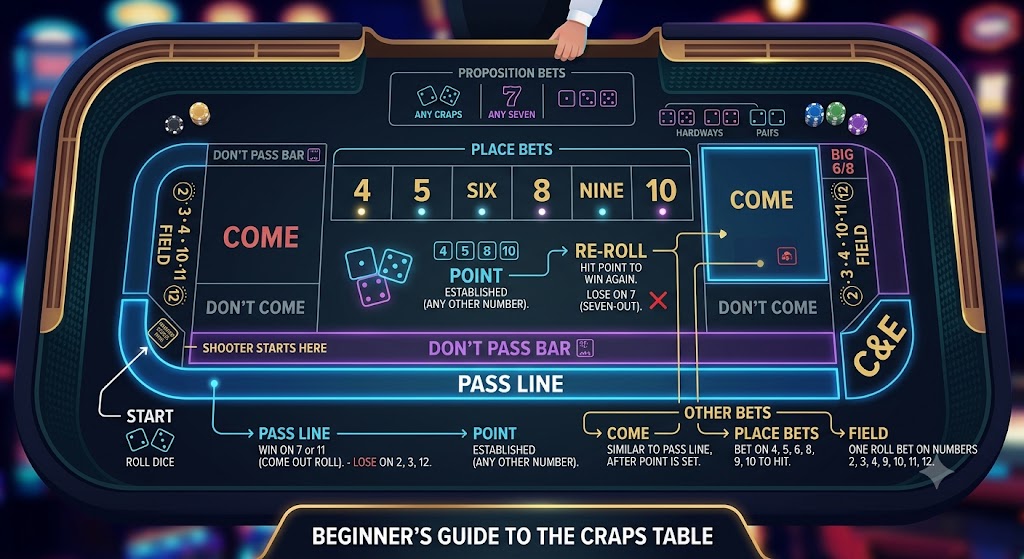
The table layout, section by section
A standard craps table has betting areas mirrored on both long sides, plus one shared centre strip.
- Pass line. The band along the outer edge of the table, closest to the players. This is where most beginners place their first bet.
- Don’t pass bar. A narrower strip just above the pass line, on the player’s side. Bets here go against the shooter.
- Field. A large boxed section with 2, 3, 4, 9, 10, 11 and 12. It is a one-roll bet, resolved on the very next throw.
- Come and don’t come. Boxed areas between the field and the box numbers. They work like pass and don’t pass, except a come bet can be placed on any roll after a point is established, which lets you start your own point.
- Box numbers (place bet row). The numbered boxes 4, 5, 6, 8, 9 and 10. Place, buy and lay bets are made here.
- Centre proposition area. The strip down the middle, handled by the stickperson. It holds hardways, any seven, any craps and other one-roll side bets.
- Big 6 and Big 8. On some tables, separate boxes near the corners let you bet on 6 or 8 rolling before a 7. Many tables use the place bet row instead, because place bets on 6 and 8 pay better for the same bet.
Line bets: pass, don’t pass, come, don’t come
Pass line. You bet the shooter rolls a 7 or 11 on the come-out, or hits the point before a 7. Even-money payout. House edge: 1.41%.
Don’t pass bar. The mirror image. You win if the shooter rolls 2 or 3 on the come-out, and you win if a 7 shows before the point repeats. A 12 on the come-out is a push. Because 12 is a push rather than a win, the don’t pass house edge is slightly lower than the pass line. House edge: 1.36%.
Come. Works like a pass line bet, but you place it after a point is established. The next roll acts as your personal come-out roll: 7 or 11 wins, 2, 3 or 12 loses, and any other number becomes your own point. The bet then moves to that number’s box. House edge: 1.41%.
Don’t come. The mirror of come, following the logic of don’t pass. House edge: 1.36%.
Don’t pass is not “betting against the shooter” in a bad way. It is the other side of the same bet, and it is mathematically the best line bet on the table by a small margin.
Odds bets: the only fair bet in the casino
Once a point is established, you can add an extra bet. “Taking odds” means backing a pass or come bet. “Laying odds” means backing a don’t pass or don’t come bet. This bet pays true mathematical odds with no house cut.
| Point | True odds (pass or come) | Payout |
|---|---|---|
| 4 or 10 | 2 to 1 | $2 for every $1 bet |
| 5 or 9 | 3 to 2 | $3 for every $2 bet |
| 6 or 8 | 6 to 5 | $6 for every $5 bet |
Casinos limit how much odds you can take. The limit is usually a multiple of your original bet, such as 3x, 4x, 5x or 10x, and it can vary by point number. The higher the multiple, the lower your combined house edge, because more of your total wager sits on the 0% portion.
This is what makes craps one of the lowest-edge games available, provided you back pass or come bets with odds and skip most of the rest of the table.
Field bet
A one-roll bet covering 2, 3, 4, 9, 10, 11 and 12. If any of those numbers hits on the very next roll, you win. A 5, 6, 7 or 8 loses. Most numbers pay even money. 2 and 12 pay double (2 to 1) at the standard setting. Some tables pay triple on 12 (3 to 1).
The house edge depends on those payouts:
- Double on both 2 and 12: 5.56% house edge.
- Triple on 12 (double on 2 only): 2.78% house edge.
Check the printed payout on the felt before you bet. The triple-12 setup roughly halves the house’s cut.
Place, buy and lay bets
Place bets let you bet directly on a number (4, 5, 6, 8, 9 or 10) becoming the point, without waiting for a come-out roll. You win if your number rolls before a 7 and lose if a 7 shows first.
| Number | Place bet pays | House edge |
|---|---|---|
| 6 or 8 | 7 to 6 | 1.52% |
| 5 or 9 | 7 to 5 | 4.00% |
| 4 or 10 | 9 to 5 | 6.67% |
Place bets on 6 and 8 are among the better bets on the table. Place bets on 4 and 10 are much weaker, and a buy bet is usually the better way to bet on those numbers.
Buy bets pay true odds (2 to 1 on 4 or 10, 3 to 2 on 5 or 9, 6 to 5 on 6 or 8) in exchange for a 5% commission. The commission is taken on the amount you bet. If it is taken on the whole bet, the house edge is about 4.76%. Some casinos take commission only on winning bets, which gives a lower edge. Check the table before you buy a number.
Lay bets are the don’t-side equivalent: you bet that a 7 rolls before your chosen number. The commission is taken on the amount you can win. Its size depends on how the casino charges it. Casino.org gives these figures:
| Lay bet | Commission on all lay bets | Commission only on winning lay bets |
|---|---|---|
| 4 or 10 | about 2.5% | about 1.7% |
| 5 or 9 | about 3.3% | about 2% |
| 6 or 8 | about 4% | about 2.3% |
Lay 4 or 10 has the lowest edge of the three. Check the table’s commission rules before you lay a number.
Proposition bets and hardways
These live in the centre strip and are handled by the stickperson. Most of them carry a steep house edge, which is why they are pushed so hard: big payouts, poor maths.
- Hardways. A bet that a specific pair (for example, two 3s for hard 6) rolls before the same total rolls the “easy” way or a 7 shows. Hard 6 and hard 8 pay 9 to 1, with a 9.09% house edge. Hard 4 and hard 10 pay 7 to 1, with an 11.11% house edge.
- Any seven. A one-roll bet that the next roll is a 7. Pays 4 to 1. Seven is the most common roll, which makes the house edge 16.67%, the worst standard bet on the table.
- Any craps. A one-roll bet on 2, 3 or 12. Pays 7 to 1. House edge: 11.11%.
- Horn bet. A combined one-roll bet split across 2, 3, 11 and 12. Its house edge depends on how the casino splits the payout, so check the table before you bet.
If there is a beginner strategy at all, it is this: everything in this section is optional entertainment, not a plan.
Common beginner mistakes
- Starting with proposition bets. The big payouts are tempting. They are the worst value on the table, so start with pass line and odds.
- Taking odds without a pass or come bet. Odds only exist behind a line bet, so you need the pass line first.
- Choosing place or buy on 4 and 10 without checking the commission. Buy is usually better for 4 and 10, but check the table’s commission rules.
- Adding bets to recover the last round. A new come-out roll starts with a clean slate.
- Touching chips or dice that are not yours. Only the shooter touches the dice. Players should not touch chips they did not place.
Table etiquette for beginners
Cash goes on the felt, and the dealer converts it to chips in front of you. Bets go in the correct box. The shooter rolls the dice with one hand, and the dice must hit the far wall of the table. Soft, deliberate throws keep the game moving.
If you are not sure where a bet goes, tell the dealer what you want rather than reaching across the layout yourself. They will place it for you.
Printable reference: house edge of the main bets
| Bet | House edge | Notes |
|---|---|---|
| Pass line | 1.41% | Foundation bet |
| Don’t pass | 1.36% | Mirror of pass line, 12 is a push |
| Come | 1.41% | Pass line, placed mid-round |
| Don’t come | 1.36% | Don’t pass, placed mid-round |
| Odds (pass or come) | 0% | No house cut, limited by table maximum |
| Place 6 or 8 | 1.52% | Strong bet |
| Buy 4 or 10 | about 4.76% | If commission is on the whole bet |
| Place 5 or 9 | 4.00% | Weak |
| Place 4 or 10 | 6.67% | Weakest place bet |
| Field (triple on 12) | 2.78% | Some tables only |
| Field (double on 2 and 12) | 5.56% | Standard on many tables |
| Big 6 or Big 8 | 9.09% | Use place 6 or 8 instead |
| Hard 6 or 8 | 9.09% | Avoid |
| Hard 4 or 10 | 11.11% | Avoid |
| Any craps | 11.11% | Avoid |
| Any seven | 16.67% | Worst standard bet on the table |
Save or screenshot this table. It is the most useful thing to have with you the first few times you play.
How the numbers were checked
The payouts come from the sources below and match each other. The house edges were checked with the arithmetic of the 36 dice outcomes:
- Any seven. Six of 36 outcomes win at 4 to 1, and 30 lose. The expected result per unit is (6 × 4 − 30) / 36 = −16.67%.
- Field, triple on 12. Winning outcomes pay 14 ways at 1 to 1, the 2 at 2 to 1 and the 12 at 3 to 1. Losing outcomes are 20 ways. The expected result is (19 − 20) / 36 = −2.78%. With double on 12, it is (18 − 20) / 36 = −5.56%.
- Hard 6 and hard 8. With 9 to 1 payouts, the expected result is −9.09%.
- Place 4 or 10. A 9 to 5 bet against a 2 to 1 true-odds bet gives −6.67% per unit.
- Pass line. 244 winning and 251 losing outcomes out of 495 give −1.41%.
Sources
- Live! Casino Virginia, Craps Gaming Guide (2025). Describes pass line, don’t pass (12 is a push), come, place payouts (9 to 5, 7 to 5, 7 to 6), field payouts (2 and 12 pay 2 to 1), hardways, any seven (4 to 1), any craps (7 to 1), and the 5% commission on buy and lay bets. Odds up to 10x. PDF
- Caesars, craps rack card (2016). Lists the don’t pass 12 push, true-odds payouts (2 to 1, 3 to 2, 6 to 5), lay odds (1 to 2, 2 to 3, 5 to 6), hardway and any craps payouts, and the 2 and 12 double on the field. PDF
- Casino.org, “What Is A Craps Lay Bet” (2024). The lay bet house edges with commission on all lay bets and only on winning lay bets. Article
Gambling involves financial risk. Only play with money you can afford to lose. 18+.
About the author
Marcus Reed
104 articlesTrending
Dice games compared: crypto dice, craps and sic bo

How to Stop Gambling: A Practical Plan
How Many Slots on a Roulette Wheel?

Here’s How Uniswap Liquidity Works & How To Profit From It