Traditional vs Crypto Betting

Most comparisons between crypto sportsbooks and traditional bookmakers focus on speed, fees, or anonymity. There is a simpler, more concrete angle that most players never check: what happens to your winnings at tax time, and whether that changes depending on whether you got paid in dollars or in Bitcoin.
The honest answer is that the tax picture varies enormously by country, and crypto rarely gets its own separate rulebook. In most places, a win is a win, and the tax office does not care what currency it arrived in. What changes with crypto is not usually the tax on the win itself, but a second layer: what happens later, when you sell or convert the crypto you won.
Here is what is actually confirmed, country by country, on both fronts: the tax on a traditional win, and how crypto changes (or does not change) that picture.
Player Winnings Tax: Traditional vs Crypto
| Country | Traditional winnings tax | Crypto winnings, confirmed |
|---|---|---|
| USA | Taxable as ordinary income, 10-37%, regardless of platform | Same tax on the win, plus a separate capital gain/loss when the crypto is later sold or converted |
| UK | 0%, tax-free for players since 2001, operators taxed instead | No player tax framework changes; the 0% rule applies regardless of currency, though UKGC-licensed sites do not yet accept crypto deposits |
| Germany | No direct win tax, but a 5.3% stake tax applies to sports bets, indirectly reducing returns | Licensed operators cannot accept crypto at all under GlüStV, so the stake tax framework does not apply to crypto play |
| Canada | Tax-free for recreational players (legal windfall principle); professional gamblers taxed as business income | Same recreational exemption applies to the win itself; a later rise in the crypto’s value when sold is a separate capital gain |
| Australia | Tax-free for recreational players, no threshold; professional gamblers taxed as income | Same recreational exemption; selling won crypto later for a higher price triggers a separate capital gains event |
| Brazil | 15% withheld at source on net sports betting prizes (Lei 14.790/2023); 30% flat on other games of chance | Crypto payments for licensed betting are banned outright (Ordinance 615/2024), so this framework legally does not apply to crypto |
| Argentina | Winnings from regulated games are exempt from income tax; a separate indirect tax (2.5% to 15%) is withheld on deposits, not winnings | No confirmed separate crypto rule; provincial licensing (e.g. Buenos Aires) is starting to permit crypto operators directly |
| France | Tax-free for recreational players at ANJ-licensed operators | No confirmed separate crypto rule; as of June 2025 one ANJ-licensed operator (YESorNO, via Lyzi) accepts crypto as an intermediary payment method |
| Italy | Tax-free for players at ADM-licensed operators; only lottery prizes over €500 taxed at 20% | No confirmed separate rule for gambling wins; general crypto capital gains tax (33% from 2026) applies when disposing of crypto assets, separately from any gambling context |
How Much a Player Actually Loses: Traditional vs Crypto Margin

Legal status is one thing, but there is a second, purely mathematical gap between the two models: the bookmaker’s built-in margin, also called the vig, juice, or overround.
On a standard traditional sportsbook line (the classic -110 on both sides of a point spread), the built-in margin is about 4.76%, and mainstream football 1X2 markets typically run a 5% to 8% overround at major operators, climbing to 12% or higher at smaller, recreational-focused bookmakers. Horse racing markets can run even higher, 15% to 20% in some cases.
Crypto sportsbooks generally compete on a lower structural cost base (no banking fees, lighter compliance overhead), and commonly advertise margins closer to 2.5% on straightforward two-way markets.
What that gap means in practice: a bettor placing 1,000 bets at an average $50 stake pays roughly $1,250 in margin over time at a 2.5% book, versus roughly $6,000 at a 12% book, a difference of about $4,750 that never shows up as a single fee, just as slightly worse odds on every single bet.
English-Speaking Markets: USA, UK, Canada, Australia
These four markets share a pattern: traditional sports betting is broadly legal and regulated, but not one of them lets a licensed operator take a crypto deposit yet.
- USA: legal in 39 states plus DC as of August 2026, but no state-licensed sportsbook accepts crypto directly; offshore crypto sportsbooks sit in a legal gray area under the Wire Act, which targets operators, not bettors.
- UK: the most tightly regulated of the four, but also the one showing the clearest signal of change. In February 2026, the UK Gambling Commission announced it is actively exploring a path for licensed operators to accept crypto, driven partly by an unlicensed market that has grown from 2% to 9% of the total market since 2022.
- Canada: single-event sports betting legalized nationally in 2021 (Bill C-218), with Ontario running the country’s most developed regulated market, but AGCO-registered operators still avoid crypto due to FINTRAC anti-money-laundering rules.
- Australia: sports betting permitted broadly under the Interactive Gambling Act 2001, but local operators are banned from offering in-play betting and welcome bonuses entirely, which is part of why so many Australians already use offshore, crypto-friendly sportsbooks for exactly those features.
Continental Europe: Germany, France, Italy
These three run some of the strictest licensing regimes in the world, and all three currently exclude crypto from licensed operators, though each is showing a slightly different crack in that wall.
- Germany: GlüStV caps slot stakes at €1 per spin and deposits at €1,000 per month, and explicitly does not recognize crypto as an approved payment method for licensed operators.
- France: only three categories of online gambling are permitted at all (sports betting, horse racing, poker), online casino is banned entirely, and the ANJ-licensed model is structurally hard to reconcile with pseudonymous crypto, with one narrow exception: since June 2025, one licensed operator has begun accepting crypto through an intermediary payment partner, a first for the French market.
- Italy: the ADM framework does not explicitly ban crypto, it simply writes its rules in euros, which lawyers describe as a technology gap in the law rather than a deliberate prohibition, and Italy’s 2026 reforms are pushing toward requiring any crypto-adjacent flows to go through approved, traceable channels rather than banning them outright.
South America: Brazil, Argentina
Brazil and Argentina show two very different approaches within the same region.
- Brazil: sports betting legalized and regulated nationally as of January 2025, with the clearest anti-crypto stance of any country in this list. Ordinance SPA/MF No. 615/2024 explicitly bans licensed operators from accepting any virtual asset, all deposits must run through PIX, bank transfer, or debit card tied to a verified national tax ID. Despite the ban, research from Instituto Locomotiva found 28% of Brazilian bettors admit to having used crypto to deposit at least once, almost entirely through offshore platforms.
- Argentina: no national gambling law at all, regulation happens province by province across 24 jurisdictions, and there is no confirmed national rule on crypto in gambling either way. The clearest data point is that Stake launched a fully licensed, crypto-accepting operation in Buenos Aires province in 2026, showing that at least one Argentine jurisdiction is willing to license crypto-native operators directly, a genuinely different approach from Brazil’s outright ban.
What’s Actually Changing (Confirmed Only)
A few concrete, sourced developments worth watching:
UK: The Gambling Commission’s Industry Forum was tasked in February 2026 with exploring a “sensible pathway” for licensed crypto payments, tied to the UK’s incoming Financial Conduct Authority cryptoasset regime, expected to take effect on 25 October 2027. Nothing is approved yet, this is an active review, not a rule change.
France: Since June 2025, ANJ-licensed operator YESorNO has processed crypto payments through payment partner Lyzi, the first confirmed case of a licensed French operator touching crypto at all, though it remains a single, narrow exception rather than a general policy shift.
Argentina: Buenos Aires province licensing a crypto-native operator (Stake) in 2026 is the clearest confirmed sign that provincial licensing in Argentina can accommodate crypto operators directly, even with no national framework in place.
Italy: The 2026 reform package explicitly frames crypto as something to be channeled through approved, traceable payment routes rather than banned, which several legal commentators read as groundwork for eventual crypto accommodation rather than permanent exclusion.
No country in this list has fully legalized crypto deposits at licensed sportsbooks yet. What is changing is the posture: from silence, to active review, to narrow pilot exceptions.
The Pattern That Repeats
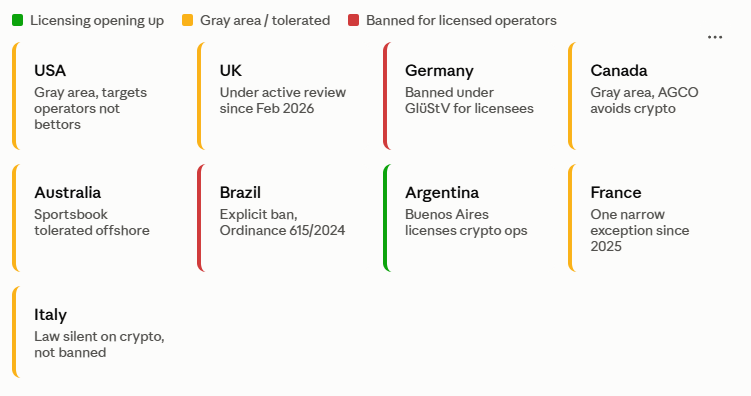
A few things hold true across all nine countries, regardless of region or regulatory style:
Every single one treats crypto sportsbooks as a gray area for the player and a compliance target for the operator, never the reverse. Not one country prosecutes bettors for using an offshore crypto sportsbook, even where the operator itself would be operating illegally.
Tax treatment of the win itself almost never changes because it happens to be paid in crypto. What changes is what happens after, when that crypto is converted or sold, which usually falls under general crypto tax rules rather than gambling tax rules.
And the countries with the strictest fiat gambling regulation (Germany, France, Brazil) are consistently the ones most resistant to crypto, while looser or more provincial systems (Argentina, parts of the offshore-tolerant Anglosphere) show the earliest real openings.
Where This Leaves You
For virtually all nine countries, the practical reality is the same: local law targets the operator, not the individual placing a bet, which is exactly why offshore crypto sportsbooks remain a live option almost everywhere on this list despite zero countries having fully legalized the model. The margin math adds a second, purely financial reason to prefer the crypto side of that gray area even where the legal status is identical.
None of this is tax or legal advice, rules shift fast and enforcement varies by country, so check your local position before assuming any of the above still applies by the time you read this.
Here’s a link to check odds and place a bet at -> Wolfbet
About the author
Marcus Reed
80 articlesTrending
![Piggy Riches 2 Megaways Review [RED TIGER]](https://wolfbet.com/blog/wp-content/uploads/2025/02/piggy-riches-2-megaways-slot-casino-online-game-768x422.jpg)
Piggy Riches 2 Megaways Review [RED TIGER]
![Best Craps Strategy [GUIDE]: How to Win at Online Craps in 2026](https://wolfbet.com/blog/wp-content/uploads/2025/02/best-craps-strategy-people-playing-craps-768x439.webp)
Best Craps Strategy [GUIDE]: How to Win at Online Craps in 2026

What Is RTP in Slots?

Bitcoin Casino Pakistan 2026: Legal Status, Crypto Gambling and Tax Guide

![The Best Bitcoin Wallet For Online Gambling [Review]](https://wolfbet.com/blog/wp-content/uploads/2025/01/Wolf.bet-Best-Bitcoin-Wallet-for-Online-Gambling-THUMBNAIL-768x256.jpeg)
![Top 7 Casino Slots in January [Wolfbet]](https://wolfbet.com/blog/wp-content/uploads/2025/01/most-popular-slots-january-e1738174312191-768x397.jpg)