
How Dice Went From Illegal in Rome to Legal in Your Browser

Banned by an Empire, Never Died: How Dice Went From Illegal in Rome to Legal in Your Browser
Dice gambling is older than Christianity, older than the Colosseum, and older than the concept of a casino itself. It survived a Roman ban, a medieval myth, and a New Orleans makeover, and it is still, after four thousand years, one of the simplest bets you can make.
Ancient Rome: betting on a roll, illegally, for centuries
Slots to try on Wolfbet Casino


The Romans had two main ways to gamble with dice. Tali used four knucklebones from animals, each marked with the values one, three, four and six. Tesserae used three cube shaped dice, made from bronze, marble, gold or even amber, with players betting on rolling three sixes or the highest combined total. The dice were shaken by hand or tossed from a special cup called a fritillus.
Here is the part that makes this genuinely wild: gambling on dice was against Roman law. The Lex Alearia and later legislation under Augustus criminalized betting real stakes, with fines reaching four times the original wager. It did not matter. Soldiers gambled in their barracks, slaves gambled with pebbles and nuts as makeshift currency, and Emperor Augustus himself played dice games in his own palace. The ban existed on paper. In practice, an entire empire ignored it.
Medieval England: the game that outlived a legend
Jump forward more than a thousand years and dice gambling resurfaces in medieval England under the name Hazard, mentioned by name in Geoffrey Chaucer’s Canterbury Tales in the 14th century. Despite rules complicated enough to make a modern player wince, Hazard became hugely popular in the 17th and 18th centuries, especially at London’s Crockford’s Club, where real money changed hands over every roll.
There is a popular legend that an English knight named William of Tyre invented the game in 1125 during a siege of a castle called Hazarth, and that the game simply took the castle’s name. It is a great story. It is also almost certainly not true, and the actual origin of Hazard remains genuinely unclear even to historians who specialize in it.
New Orleans and the birth of craps
Hazard eventually made its way to America, where it went through a heavy simplification, largely centered around New Orleans, and emerged as the game we now call craps. The rules got faster, the betting got simpler, and the game shed most of the complexity that made Hazard a challenge to learn.
The final piece of the modern puzzle came in 1907, when American dice maker John H. Winn introduced the Don’t Pass bet and redesigned the table layout. This single change is credited with solving the loaded dice problem that had plagued dice gambling for decades, and it is Winn’s version, known as bank craps, that forms the backbone of the dice game played in casinos today.
What that four thousand year old bet looks like today
Strip away the history and here is that same bet, rendered as a slider on a screen.
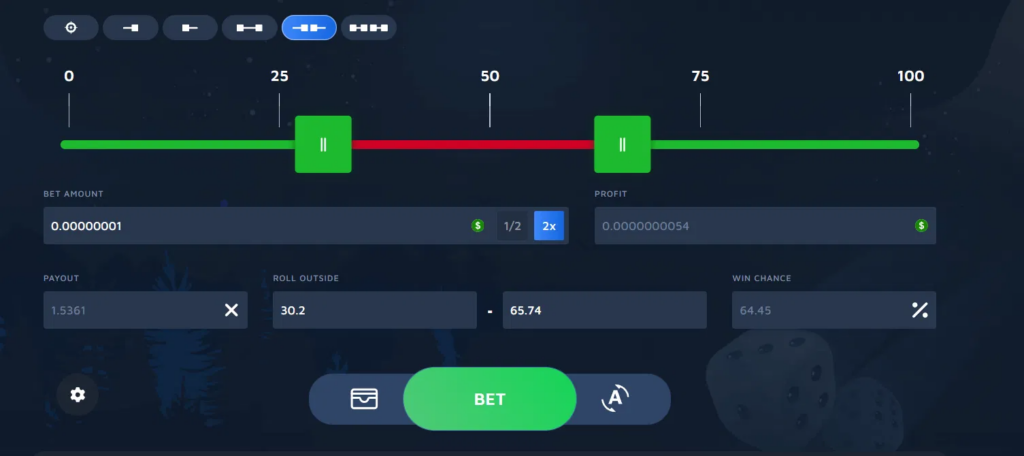
Wolfbet’s Dice game, set to Roll Outside mode
This is the Roll Outside mode, one of several bet types available in the game (the other modes, roll under, roll over, and roll between, sit as icons along the top of the screen).
The slider running from 0 to 100 has two green handles, set here to 30.2 and 65.74. The red section between them is the losing zone, and the green sections on either side are the winning zone. In Roll Outside mode, you win if the number that gets rolled lands outside the red zone, meaning below 30.2 or above 65.74.
Bet Amount and Profit update live as you move the sliders, showing your stake and potential payout in real time. Payout shows the multiplier you would receive on a win, here 1.5361x, and it moves inversely with your win chance: shrink the red losing zone and the payout drops, because winning gets easier. Win Chance shows your exact probability of winning at the current settings, here 64.45%, calculated automatically the moment you adjust the sliders.
That is the entire mechanic. A Roman soldier rolling Tali in his barracks was making the same kind of bet, betting on where a random outcome would land, he just did not have a slider showing him his exact odds before he threw.
Here’s a link to try Dice yourself -> Dice on Wolfbet
Wolfbet supports deposits in Bitcoin, Ethereum, Litecoin and several other cryptocurrencies, you can see the full list here
About the author
Marcus Reed
90 articlesTrending

How to Use Crypto Casino Bonuses for Dice Games

What Is a Face Card?
Wild Wild Riches Megaways Slot Review
![Fruit Million Review [BGaming]](https://wolfbet.com/blog/wp-content/uploads/2025/02/fruit-million-slot-casino-game-bgaming-768x400.jpg)
Fruit Million Review [BGaming]
![Poker Basics for Beginners [GUIDE]](https://wolfbet.com/blog/wp-content/uploads/2025/01/poker-begginers-768x439.webp)



![Craps Basics for Beginners [GUIDE]](https://wolfbet.com/blog/wp-content/uploads/2025/01/craps-beginners-e1737908056589-768x439.webp)