Dice Strategy Bitcoin: What Actually Works in 2026
Updated: 27 October 2026
No dice strategy changes the house edge. Martingale, Paroli and D’Alembert change how your balance moves from roll to roll, and that can make a session feel better or worse. They cannot make the expected result positive. If a strategy promises guaranteed profit, look at the bet sizes: the losses are still there, just hidden in the sequence.
This guide is for players who have placed a few bitcoin dice rolls, whether you play crypto dice or bitcoin dice, and want to know which system to use, what it does to your bankroll, and how to keep the risk under control. You will get worked examples for the three systems people ask about most, a short look at other progressions, and the bankroll rules that matter more than any system.
Slots to try on Wolfbet Casino


In this guide:
- How bitcoin dice works in 60 seconds
- Why no strategy beats the house edge
- Martingale, Paroli and D’Alembert explained
- Other betting systems
- Bankroll rules that matter more than the system
- Mistakes that cost the most
- What to check on a platform
- How to check that a roll is fair
- FAQ
How bitcoin dice works in 60 seconds
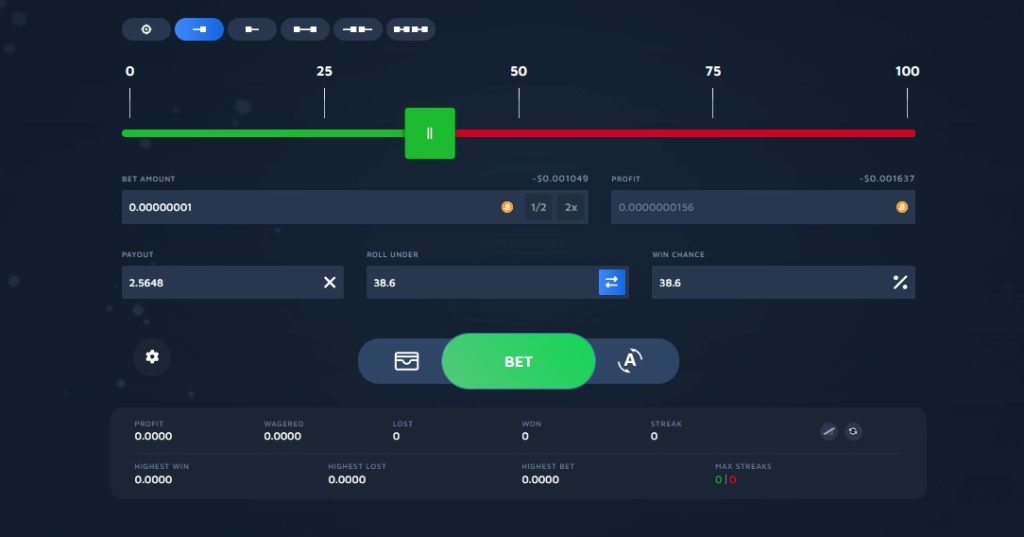
Bitcoin dice rolls a number between 0.00 and 99.99. The exact range depends on the site. You pick a target and bet on whether the roll lands under it or over it. The lower your win chance, the higher your multiplier.
The multiplier follows a simple relationship:
Multiplier = (100 – house edge) / win chance
At a 1% house edge and a 49.5% win chance, the multiplier is 2.00x. At a 90% win chance it drops to about 1.10x. Check the house edge and RTP in the game’s info panel before you bet, because they vary between games and sites.
New to the game? Start with the crypto dice guide and come back here once you know the controls.
Why no strategy beats the house edge
The house edge is the share of every bet the casino keeps over time. At a 1% edge, you should expect to lose about $1 for every $100 you wager, no matter what sequence of bets you place. For the detailed math, see crypto dice house edge explained.
Scientific American makes the same point for games like this one: when your chance of winning is 50% or less, no betting strategy gives you an advantage in a finite game, and Martingale is the classic example of that trap (Scientific American). A university lecture on expected value reaches the same conclusion: whatever betting system you use, your expected loss per dollar stays equal to the house edge (HKU, expected values).
A strategy changes the shape of your results. It can make wins more frequent, or make losses rarer and larger. It does not change the average. That is the most useful thing to know before you pick a system.
Martingale system: double after every loss
Martingale doubles your bet after each loss. The first win recovers everything you lost and adds one base bet of profit.
Example with a $5 base bet:
| Roll | Bet | Result | Running total |
|---|---|---|---|
| 1 | $5 | Lose | -$5 |
| 2 | $10 | Lose | -$15 |
| 3 | $20 | Lose | -$35 |
| 4 | $40 | Win at 2.00x, pays $80 | +$5 |
The catch is the losing streak. The bets in a run of losses go $5, $10, $20, $40, $80, $160, $320, and so on. After seven straight losses you have risked $635 in total, and the next bet is $640. At a 49.5% win chance, the chance of seven straight losses is about 0.84%. That is rare, but it is exactly the scenario that empties a bankroll.
The strategy has a long history. It dates back to 18th-century France, and it only looks like a sure win in theory, with unlimited money, unlimited bets and unlimited time. Real tables and bankrolls have all three limits (Wikipedia, Martingale).
Martingale suits short sessions with a large bankroll and a firm stop-loss. It does not suit a small bankroll, and it does not beat the house edge over time.
Paroli system: double after every win
Paroli is the reverse of Martingale. You double after each win and reset after three wins in a row, or after any loss. Your risk per cycle stays at one base bet.
Example with a $10 base bet:
- Win $10 (profit $10). Next bet: $20.
- Win $20 (profit $30 in total). Next bet: $40.
- Win $40 (profit $70 in total). Reset to $10.
- Lose $10 on the next bet. Net for the cycle: +$60.
Paroli limits how much you can lose in one cycle, but the profit depends on streaks you cannot predict. The three-win reset also means you give up any longer streak.
D’Alembert system: add or subtract one unit
D’Alembert is the gentlest of the three. After a loss you add one unit to the next bet. After a win you subtract one unit. The bet changes slowly, so the swings are smaller.
Example with a $2 unit, starting at $10:
- Lose $10. Next bet: $12.
- Lose $12. Next bet: $14.
- Win $14. Next bet: $12.
- Win $12. Next bet: $10.
After those four rolls you are up $4. The math still applies: the expected result is negative, just more slowly.
Other betting systems
- Fibonacci betting system follows the sequence 1, 1, 2, 3, 5, 8. You move one step forward after a loss and two steps back after a win. It grows more slowly than Martingale, but a long losing streak still means a large bet.
- Labouchere system starts from a list of numbers, such as 1-2-3. You bet the first number plus the last, cross both off after a win, and add the bet to the end of the list after a loss. The session ends when the list is empty. The list can grow fast after a bad run.
- Oscar’s Grind aims for one unit of profit per session. You never raise the bet after a loss, only after a win, and you stop once you are up one unit. Recovering from a losing streak takes a long time.
None of these changes the expected result. They change how your balance moves.
Bankroll rules that matter more than the system
How much you bet relative to your balance matters more than which system you pick. Three rules do most of the work:
- Bet 1-2% of your bankroll as the base bet. Smaller bets make a losing streak survivable.
- Test the system against your bankroll before you start. Take the worst-case total risk of the system and compare it with your balance. For Martingale with seven steps from a base bet, the total risked is 127 times the base bet. A $500 bankroll supports a base bet of about $3.90, not $5. When the 1% rule and Martingale conflict, follow the stricter one.
- Set a stop-loss and a stop-win before you start. Auto-bet tools let you set both. Do not change the limits during a session.
For the full bankroll framework, read dice bankroll management.
Mistakes that cost the most
- Chasing losses. Raising the bet beyond what the system says after a bad run turns a small loss into a large one.
- Treating a lower win chance as better odds. A lower win chance gives bigger swings, not a better expected result.
- Moving the stop-loss mid-session. The limit you set before playing is the one that protects you.
- Playing with money you need. The expected result is negative, so treat the stake as the cost of entertainment.
Emotion is the common thread. Players who stick to a plan and stop at their limit keep their money longer. Players who switch systems after a streak usually lose more than the system would have cost them. For a longer list, see 10 costly mistakes beginners make in crypto dice.
What to check on a platform
Before you use any system, check four things:
- Provably fair setup, so you can verify every roll
- House edge or RTP for the exact dice game you are playing
- Auto-bet with stop conditions, so the system stops when your limits are reached
- Licensing and deposit and withdrawal terms, read before you deposit
If you plan to use a bonus, check the wagering rules first. Crypto casino bonuses for dice explains how they affect the math.
How to check that a roll is fair
Provably fair systems let you confirm that a roll was not changed after you placed the bet. Before you bet, the site shows a hash of its server seed. After the session, it reveals the server seed, so you can recompute the result from your client seed and the nonce. On Wolfbet, the Verification tab on the Provably Fair page runs that calculation for you.
A full walkthrough is in how to manually verify your crypto dice rolls. For the concept, read provably fair gambling: how Wolfbet’s system works.
FAQ
What is the best dice strategy?
There is no mathematically best one. Every system works inside the house edge, so the average result stays negative. A system can change how often you win and how big the swings are, but it cannot make the expected result positive. Pick the one whose swings you can live with.
Which strategy should a beginner use?
D’Alembert is the easiest to follow, and its swings are the smallest. Pair it with a base bet of 1-2% of your bankroll and a stop-loss. You will still lose money over time, but you will lose it more slowly and with fewer surprises.
Does Martingale work on bitcoin dice?
It can recover losses within a session if your bankroll is large enough and the site’s maximum bet does not stop you first. Over many sessions the house edge still wins, and one long losing streak can wipe out the bankroll.
Can I check that bitcoin dice is fair?
Yes, on provably fair sites. Use the platform’s verification tool or a third-party checker to confirm each roll. The step-by-step guide covers it.
Conclusion
No dice strategy beats the house edge, but the right system and the right bankroll rules keep your sessions controlled and your losses predictable. Pick one system, set your base bet and limits before you start, and stick to them. If you want to test these rules with small stakes, the Wolfbet dice game is the place to do it.
Gambling involves financial risk. Only play with money you can afford to lose. 18+.
About the author
Marcus Reed
101 articlesTrending

What is sit n go Poker

Blood Suckers Megaways by Red Tiger Review

Big Bass Vegas Double Down Deluxe Slot Review

What Is Asian Total in Betting? Complete Guide to Over/Under Quarter Lines