What is nit in Poker – Full Explained
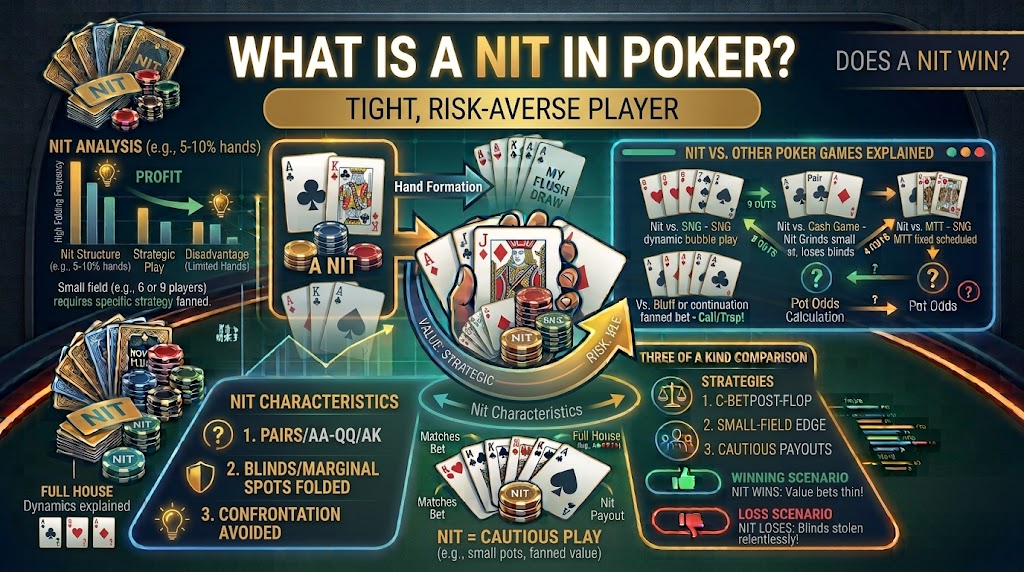
A nit in poker is an extremely tight, risk-averse player who plays very few hands and only gets involved with premium holdings. A nit folds almost everything, rarely bluffs, and avoids big pots unless they hold close to the best possible hand. Their whole approach is built around not losing chips rather than winning them.
Being called a nit is not a compliment. It marks a player who is so cautious that they leave money on the table and become easy to read.
What a nit does at the table
A nit poker player shows a clear, repeatable pattern:
- They enter very few pots. In a full-ring game a nit’s VPIP (the percentage of hands they voluntarily play) sits around 10 to 12 percent, and under 15 percent in 6-max. The most extreme nits play as little as one hand in twenty.
- They wait for premium hands: big pairs and Ace-King, and little else.
- They almost never bluff, so their bets and raises mean a genuinely strong hand.
- They fold to pressure, give up their blinds without a fight, and rarely defend marginal spots.
- They play the same way no matter who they are against, and often look disengaged, folding on autopilot.
The upside is that a nit is predictable. The downside for them is that everyone else can see it coming.
Why is it called a nit?
The word comes straight from ordinary English. A nit is the egg of a louse, and by extension a “nitpicker” is someone who frets over tiny, unimportant details. Poker borrowed the term for a player who agonises over every chip and refuses to gamble. The name captures the attitude better than any stat: small-minded with money, unwilling to take a risk.
Nit vs TAG: tight is not the problem
Playing tight is not a mistake on its own. The best cash-game regulars are tight too. The difference is aggression.
A TAG (tight-aggressive) player also folds a lot preflop, but plays a wider strong range, bets and raises for value, bluffs at the right times, and stays unpredictable. That combination wins. A nit is tight and passive: they check and call, avoid confrontation, and only come alive with a monster. Same folding habit, opposite results. The passivity is what turns a disciplined tight style into a losing one.
Is it good to be a nit in poker?
Generally, no. A nit can grind out a small profit against very loose, bad players who pay them off, but against anyone paying attention it is a losing style. Two problems drag a nit down. First, they fold so often that they bleed blinds and small pots all session. Second, when they finally bet, observant opponents simply fold, so the big hands a nit waited for win almost nothing.
For a beginner, playing tight is a reasonable starting point. The leak to fix is the fear: folding too much, never bluffing, and refusing to put chips in without the near-nuts.
How to spot a nit
You can usually label a nit within an orbit or two:
- They have folded almost every hand you have seen.
- Every showdown they reach, they turn over a big hand.
- They never seem to defend their big blind against a raise.
- They show no aggression after the flop unless the board smashed them.
Online, tracking software makes it obvious: a VPIP under 12 in full ring, or under 15 in 6-max, with a passive postflop profile, is a nit.
How to play against a nit
A nit’s tight, passive range is one of the easiest to attack. The plan is simple: take the small pots for free and get out of the way when they finally fight back.
- Steal their blinds relentlessly. When it folds to you in late position and a nit is in the blinds, raise almost every time. They will fold and hand you the pot.
- 3-bet them light. When a nit opens from late position, re-raise with a wider range than normal. Anything short of a premium and they fold.
- Bet bigger when you bluff. Nits are sensitive to pressure, so size up when you represent strength.
- Barrel scare cards. If an overcard or a flush completes and the nit checks, a turn or river bet usually wins it.
- Value bet thin. When a nit does call you down, their range is capped, so you can bet good-not-great hands and still get paid.
- Fold when they wake up. If a passive nit suddenly raises the turn or river, believe it and release your marginal hands. Paying off a nit is where the value you stole goes back.
What is the nit button in poker?
The nit button is a home-game device made to punish overly cautious play. It works like a running penalty:
- At the start of the session, every player is given a nit button.
- A player gets rid of their button by doing something bold enough to prove they are not playing scared. The exact trigger is a house rule, for example showing down a bluff, winning a big pot, or getting caught folding a strong hand.
- Whoever is still holding a nit button at the agreed cut-off point (end of the night, or after a set number of hands) pays a penalty, usually a fixed amount to every other player.
Because the details are house rules, agree on how the button is lost and what the penalty is before the first hand. The point is to inject action and stop the table from grinding to a nitty halt.
What is a nit game?
“Nit game” is used two ways. Most often it describes a table full of nits: a tight, low-action game where nobody gambles and it is hard to win much, because the only time you get paid is when someone else has a big hand too. It is safe but rarely profitable.
The phrase also refers to a home-game format built around the nit button above, where the whole night runs on the penalty rules that reward action and tax passivity.
FAQ
What does nit mean in poker?
A nit is a very tight, passive player who only plays premium hands, rarely bluffs, and folds to almost any pressure. The style aims to preserve chips rather than win them.
Is being a nit good or bad?
Mostly bad. It can beat very loose, weak tables, but against observant, aggressive players a nit folds too often, loses value on their big hands, and gets their blinds stolen all session.
What is a nit’s VPIP?
Around 10 to 12 percent in full-ring games and under 15 percent in 6-max. Extreme nits play even fewer hands, sometimes close to 5 percent.
What is a nit button?
A home-game penalty device. Every player starts with one, sheds it by playing boldly, and whoever is left holding a button at the end pays a set penalty. It discourages overly tight play.
How do you beat a nit?
Attack their blinds, 3-bet their late-position opens, bluff bigger on scare cards, and value bet thin when they call. Then fold your marginal hands the moment a nit shows real aggression.
About the author
Marcus Reed
81 articlesTrending
![Top 9 BGaming Slots in Asia [January 2025]](https://wolfbet.com/blog/wp-content/uploads/2025/02/top-9-bgaming-slots-in-asia-january-2025-768x154.jpg)
Top 9 BGaming Slots in Asia [January 2025]
Lady Wolf Moon by BGaming Review
![Racino Meaning [CASINO] [GUIDE]](https://wolfbet.com/blog/wp-content/uploads/2025/02/racino-casino-screenshot-768x439.webp)
Racino Meaning [CASINO] [GUIDE]

Extra Juicy Megaways Slot Review


![Top 7 Ethereum Gambling Sites & Casinos [Reviews – 2021]](https://wolfbet.com/blog/wp-content/uploads/2025/01/Wolf.bet-_-Ethereum-Gambling-_-THUMBNAIL-768x256.jpeg)