What Are the Nuts in Poker? Meaning, Examples, and How to Spot Them
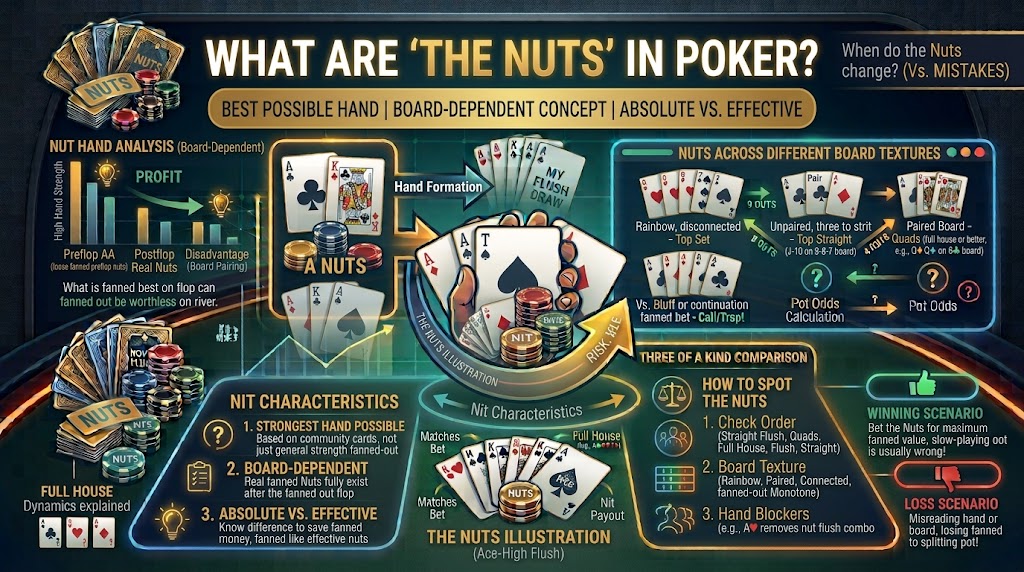
The nuts in poker is the best possible hand on the current board. If you hold the nuts, no combination of hole cards can beat you right now, only tie you in some spots. That is the whole idea in one line.
Here is a quick example. You hold A♠ T♠ and the flop comes K♠ 9♠ 4♠. You have an ace-high flush, and on that board nobody can do better. No straight flush is possible, and any other flush loses to your ace. You have the nuts.
The word gets used two ways at the table. On its own, “the nuts” means the single best hand available. As a label, players stick it in front of a hand type: the nut flush is the best possible flush, the nut straight is the best possible straight, and so on. This guide covers both, plus the part most articles skip: a repeatable way to read the nuts on any board without second-guessing yourself.
Slots to try on Wolfbet Casino


Key takeaways
- The nuts is the strongest hand possible given the community cards, not the strongest hand in general.
- It is a board-by-board concept. What is the nuts on the flop can be worthless by the river.
- There is a difference between the absolute nuts and the effective nuts, and knowing it saves you money.
- A simple check order (straight flush, quads, full house, flush, straight) lets you spot the nuts fast.
- Having the nuts, or having it more often in your range, is what lets you bet big and get paid.
What “the nuts” actually means
A poker hand is always five cards. In games like Texas Hold’em and Omaha, those five cards come from a shared board plus your hole cards, so the best possible hand depends entirely on what is on the table.
That is why the nuts only fully exists after the flop. People call pocket aces the “preflop nuts” because it is the strongest starting hand, but that is loose talk. Aces win most of the time before the flop, yet they are still just a pair, and a pair is nowhere near unbeatable once five community cards are out. The real nuts is a postflop thing.
So when someone says “I had the nuts,” they mean: given every card I could see, my five-card hand was the best one anyone at the table could possibly hold.
A clean example
You hold J♦ T♦. The board is 8♥ 9♣ Q♠.
Your hand is Q-J-T-9-8, a queen-high straight. The board is rainbow, so no flush is possible. Nothing is paired, so no full house or quads are possible. A straight is the ceiling here, and yours is the highest straight the board allows. You have the nuts.
Notice what made this easy to read: I ran down the list of stronger hands (straight flush, quads, full house, flush) and ruled each one out because the board did not support it. That is the method, and I will turn it into a checklist below.
Absolute nuts vs effective nuts
This is the distinction that separates players who lose money to coolers from players who dodge them, and almost nobody explains it clearly.
The absolute nuts is the best hand the board could ever produce. The effective nuts (also called the practical or “actual” nuts) is the best hand that anyone could realistically be holding, given the cards you can see and the cards in your own hand.
Take a board of K♥ K♠ 7♣ 3♦ 2♠.
The absolute nuts is four kings. But there are only two kings left in the deck. If you hold K-7, you have kings full of sevens, and because you are holding one of the two remaining kings, it is impossible for anyone else to have quads. Your full house is not the absolute nuts, but it is the effective nuts. You can bet it like a monster.
The lesson works in reverse too. When you do not block the top hands, respect them. On a paired board where you hold no piece of the pair, quads and better full houses are live, and your strong-looking hand might be second or third best.
How to spot the nuts on any board
Work through hand types from the top down and keep the first one the board can support. That is it.
- Straight flush – possible only when three or more cards of one suit are close in rank. Rare, but check first.
- Four of a kind – possible only when the board is paired (or trips are showing).
- Full house – possible only when the board is paired.
- Flush – possible only when three or more cards share a suit.
- Straight – possible when three cards fall within a five-rank window.
- Three of a kind / two pair / pair / high card – the ceiling on dry, disconnected, rainbow boards.
The moment you find the highest category the board allows, ask which exact holding makes the best version of it. That holding is the nuts.
Here is the same idea as a quick reference by board texture:
| Board texture | Example | What the nuts usually is |
|---|---|---|
| Rainbow, disconnected, unpaired | K♣ 8♦ 3♠ | Top set (three of a kind) |
| Unpaired, three to a straight | 9♠ 8♦ 7♣ | The top straight (J-10 here) |
| Three cards of one suit (monotone) | A♥ 9♥ 4♥ | The ace-high flush, unless a straight flush is live |
| Paired board | Q♦ Q♠ 6♣ | Quads, or the best full house |
| Paired + flush possible | J♥ J♦ 5♥… | Full house or quads beat the flush |
| Four to a straight or four to a flush | 6-7-8-9 / four hearts | The straight or flush that uses the highest missing card |
Spend a week reading the nuts on every board you see, even in hands you folded, and it becomes automatic.
Nut flush, nut straight, nut full house
When players say “nut flush” or “nut straight,” they mean the best possible version of that specific hand on the board.
The nut flush is almost always the ace-high flush. If you hold the ace of the flush suit, no other flush beats you. That is exactly why the ace of a suit is such a prized card on flush-heavy boards, and why “do I have the nut flush or just a flush?” is a question that decides whole pots.
The nut straight is the highest straight the board allows. If the board is 8-9-10, then Q-J makes the nut straight (Q-J-10-9-8), and J-7 makes a weaker straight (J-10-9-8-7) that still loses to it. A straight can feel like the nuts and quietly be second best, so always check which end you are holding.
The catch worth remembering: a “nut” hand of one type still loses to a higher category. The nut straight loses to any flush. The nut flush loses to any full house on a paired board. “Nut” means best of its kind, not unbeatable overall.
The nuts changes on every street
New community cards can hand the nuts to someone else, and this is where players bleed chips by falling in love with a flop.
Go back to J♦ T♦ on 8♥ 9♣ Q♠, where you flopped the nut straight. Now the turn is Q♥. The board is paired, so full houses and quads are suddenly possible. Your straight, unbeatable a second ago, now loses to any queen, any nine, and any pocket pair that filled up. You went from the nuts to a hand that has to slow down.
The habit to build: after every card, re-read the board from the top of the list. Do not assume the hand you had on the flop is the hand you have on the river.
Flopping the nuts
“Flopping the nuts” means your first five cards, two hole cards plus the flop, already make the best possible hand. It is one of the better feelings in poker and a genuine money-making spot, because you have three streets to build a pot while you are guaranteed the lead.
It also comes with a warning built into the last section: flopping the nuts is not the same as holding the nuts at showdown. On wet, coordinated boards, plan for the turn and river before you decide how fast to play.
Can you lose with the nuts?
You cannot be beaten with the nuts, but you can tie. That surprises people.
Split pots happen when the nuts lives entirely on the board or is shared. If both players make the same top straight using only one hole card, or if the best five-card hand is simply the five community cards, the pot is chopped. So “the nuts” occasionally guarantees you no worse than a split rather than the whole pot.
The other way to “lose” with the nuts is human error: misreading your hand and folding it, or checking it down and letting a free card counterfeit you on a later street. The cards will not beat you. Your attention might.
Relative nuts and nut advantage
Here is the strategic layer that the glossary pages leave out.
You rarely need the literal nuts to play a hand like the nuts. What matters is the relative nuts: the best hand your opponent can credibly have, based on how the action went. If a tight player folded most weak hands preflop and the board is A-3-4, the baby straight (2-5) is technically the nuts, but that player almost never has it. Against that range, top set plays like the nuts.
Zoom out one more level and you get nut advantage, one of the most useful modern concepts in No-Limit Hold’em. On some boards, one player’s range simply contains the nuts and near-nuts far more often than the other’s. On an A-K-5 flop, the preflop raiser holds hands like AK, AA and KK much more than the caller does. That player has the nut advantage, which is exactly why they can fire big bets and represent monsters believably. The player without it should be more cautious with big pots.
You do not need to memorize solver charts to use this. Just ask, before you commit chips: given this board and this action, whose range holds the top hands more often? If the answer is not you, size down or step off the gas.
Blockers and the nuts
A blocker is a card in your hand that removes a combo from your opponent’s range. It matters most around the nuts.
Say the board is 4♥ 5♥ 8♥ J♣ Q♦ and you are thinking about bluffing at a missed flush. If you hold the A♥, your opponent cannot have the nut flush, because you are holding the card that makes it. That makes your bluff far more credible and far more likely to work. The same logic runs the other way: holding a blocker to the nut straight or nut flush tells you the coordinated board is safer to attack than it looks.
Blockers will not turn a bad hand into a good one, but around the nuts they turn marginal bluffs into good ones.
How to play the nuts for value
When you have the nuts on the river, or the effective nuts on an earlier street, the goal is simple: get as many chips into the pot as the situation allows.
The instinct to slow-play, to check and trap, is usually a mistake. Every check is a bet you did not make, and on wet boards it also hands your opponents a free card that can kill your action or, worse, outdraw an earlier-street nut hand. Bet, size up on draw-heavy boards, and let your opponents pay to see if they can catch up. Save slow-playing for the rare spots where an aggressive opponent will bluff for you if you check, or where the board is so dry that a bet folds out everything.
Betting the nuts feels almost too obvious to teach, and yet leaving value on the table is one of the most common leaks in low-stakes games.
Drawing to the nuts
Not every strong hand is made yet. A nut draw is a draw to the best possible hand, and it is worth far more than a regular draw.
The classic is the nut flush draw: you hold the ace of a suit with two more of that suit on board. When you hit, you do not just make a flush, you make the flush that beats every other flush. Compare that to a low flush draw, where hitting can cost you your stack against a bigger flush. Same with an open-ended straight draw to the top straight versus the bottom one.
The takeaway: prize draws that make the nuts, and be wary of draws that make the second-best version of a hand. Hitting your card and still losing is one of the most expensive mistakes in poker.
Playing when you do not have the nuts
Most hands, you will not have the nuts, and playing well without it is where real money is made or saved.
Lean on relative hand strength and pot odds. If the pot is 100 and you have to call 50, you are getting 3-to-1, so you need to win about 25 percent of the time to break even on the call. Then weigh how often your opponent actually holds one of the hands that beats you, given the board and the action. On a scary board against a passive player who suddenly bets big, a strong-but-not-nut hand is often a fold. On a board where the top hands are unlikely in their range, the same hand is a call or a raise.
Folding the second-best hand when the read says you are beaten is a skill. It is not exciting, but it is the difference between a small loss and stacking off into the nuts.
Checking the nuts: is it really illegal?
You will hear that it is “illegal to check the nuts.” That is mostly a myth, but there is a real rule underneath it.
In most cardrooms, checking the nuts is not against the rules on its own. The problem is soft play and collusion. If you are last to act on the river with the nuts and you check instead of betting, especially against a friend, it can look like you are deliberately not taking money off another player. Tournaments like the WSOP explicitly ban soft play and can penalize it with lost chips or disqualification. Some rooms have a house rule that you must bet or that you cannot check the nuts as the last player to act, precisely to shut down collusion.
So the honest answer: checking the nuts is usually legal, but it is bad etiquette, and in the wrong spot it gets treated as soft play and punished. New players who genuinely did not realize they had the nuts are normally given a pass.
The nuts in Omaha and other games
The concept travels, but it gets sharper in Omaha. Because you must use exactly two of your four hole cards, the nuts changes constantly and beginners badly overvalue non-nut hands. In Omaha, a “good” flush or straight is often a trap, and experienced players are frequently drawing to, or holding, the actual nuts.
High-low split games add another wrinkle. There you talk about the nut low (the best possible low hand) and the nut high separately, and a hand that scoops both is a nut-nut, guaranteed at least half the pot and often all of it. If you move from Hold’em to Omaha or a split game, respect how much more the nuts matters there.
Where does the term come from?
Nobody knows for sure, and every source that says otherwise is guessing. The popular story is from the American Old West: a player betting everything would put the metal nuts from his wagon wheels into the pot, so he physically could not roll away without settling the bet, something he would only do with an unbeatable hand. That is where “stone-cold nuts” supposedly comes from too. It is a good story and almost certainly folklore. Other theories trace it to an old sense of “nuts” meaning a source of pleasure. Treat the etymology as a fun aside, not settled fact.
Frequently asked questions
Why is it “illegal” to check the nuts in poker? It usually is not literally illegal. Checking the nuts is treated as soft play or possible collusion, especially when you are last to act on the river, because you are choosing not to win chips you are entitled to. Tournaments penalize soft play, and some cardrooms have a house rule against checking the nuts in that spot.
Why is it called a nut flush? Because it is the best possible flush, which is the ace-high flush when no straight flush is available. “Nut” in front of any hand type means the strongest version of that hand on the current board.
What does “flop the nuts” mean? It means your two hole cards plus the three flop cards already make the best possible hand. You have the lead with two cards still to come, though the nuts can shift on the turn or river.
How often do you get the nuts? Not often. The exact nuts is rare, which is part of why it is valuable. Far more common, and more useful to recognize, is the effective nuts or the relative nuts, where you hold the best hand your opponent can realistically have.
What is the opposite of the nuts? Slang for the worst possible hand is the “reverse nuts” or “lemons.” As a starting hand, 7-2 offsuit is widely considered the weakest in Hold’em because it makes so few strong hands.
Can the nuts be on the board? Yes. If the five community cards make the best possible hand by themselves, for example a straight or flush that no hole cards can improve, then everyone still in the hand plays the board and the pot is split.
About the author
Marcus Reed
90 articlesTrending

Cash Maximus: Battle Arena Slot Review

Bitcoin Cash Dice: The Cheapest Roll on the Table (If You Get the Network Right)
How Many Slots on a Roulette Wheel?
How to Read Betting Odds: Decimal, Fractional, and Moneyline Explained



![Aztec Clusters slot Review [BGaming]](https://wolfbet.com/blog/wp-content/uploads/2025/02/aztec-clusters-slot-crypto-casino-768x383.jpg)